

Coordinate your wedding styling and catering by starting with the food, not the mood board. First, decide how your guests will eat: a plated dinner, sharing platters, a roaming dinner or a buffet. That choice affects your table layout, tableware, flower arrangements and the amount of space each guest needs. Then set one colour palette, one timeline and one person with final responsibility. This gives your stylist and caterer the same floor plan and event schedule to work from. Follow that order and you will not end up with a beautiful table that becomes unusable when the first course arrives.
Why can a wedding feel disjointed when every supplier does a great job?
The stylist creates a beautiful table, the caterer serves excellent food, yet the whole occasion still feels slightly off. It is rarely because one supplier has done poor work. Problems usually arise in the handovers, where one supplier’s work overlaps with another’s. (Services)
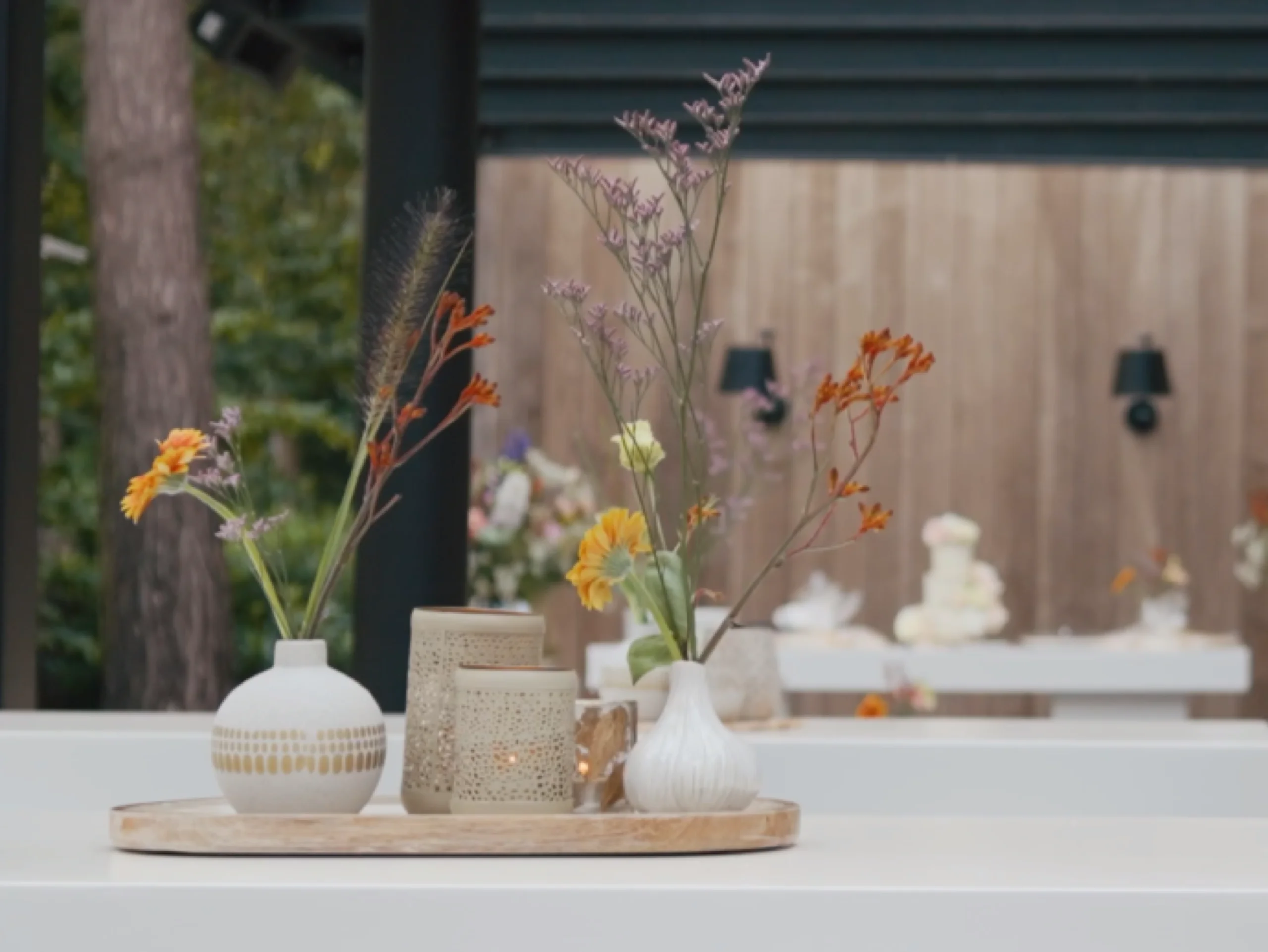
Picture a long table with tall, abundant floral arrangements running through the centre. It looks stunning in photos. But what if the caterer has planned a shared meal with large serving platters in the middle of the table? When it is time to serve, there is no room. The team has to place the flowers on the floor or push them to one side, and the styling disappears just as guests sit down.
There are plenty of other handovers that can fall through the cracks:
- Tableware and linens: the stylist hires handmade ceramic plates in a soft shade, while the caterer brings standard white porcelain. Two different looks end up on the same table.
- Buffet and bar tables: the styling stops at the dining tables, while the buffet sits in a corner with a standard table skirt.
- Lighting: candlelight creates atmosphere, but the service team needs to see what they are serving and guests need to see their plates.
- Room changeover: after dinner, the room needs to be ready for the party. The stylist wants to rearrange tables while the caterer is still clearing them.
- Menu cards: they may be beautifully printed in the wedding’s visual style, but lack the allergen information that needs to accompany the food.
Each issue seems minor on its own. Together, they determine whether your guests experience one cohesive celebration or a collection of separate elements. The real question is not who can create the prettiest table. It is who takes responsibility for the handovers.
What are the best ways to coordinate wedding styling and catering?
There are broadly three options. The main difference is who takes overall responsibility.
You manage separate suppliers yourself
You book your own stylist and caterer, then introduce them to each other. This gives you the greatest freedom of choice. You can work with the florist you have followed for years, for example. However, you are also the person sending floor plans, aligning timings and checking that one supplier’s tableware works with another supplier’s tables. In reality, this often takes more time in the final weeks before the wedding than couples expect.
One supplier leads and the other follows
This is often the caterer, because the food shapes the schedule for the day. The stylist then receives the floor plan, menu format and timeline as fixed parameters. It works well when both suppliers have worked together before. If they have not, agree in advance who has the final say if there is a conflict.
One partner handles both styling and catering
A full-service partner arranges the food, tableware, furniture, styling and often lighting and technical production too. The handovers happen within one organisation, and you have a single point of contact. The trade off is a little less freedom of choice, since you will work with their in house styles, materials and regular partners.
To see what this final option looks like from venue selection through to clear down, read about how to organise a wedding or private party without the stress. If you are deciding whether to keep individual elements separate, this guide can help you weigh up booking catering, styling and technical production separately or choosing one full-service partner.
Separate suppliers or one partner: coordinating wedding styling and catering
First, one point that most inspiration pages overlook: the meal format should shape the styling, not the other way around. Many couples book a stylist based on a mood board, then decide on the dinner later. That is how the clashes described above happen. Reverse the process and your stylist has practical parameters to work with: table widths, what needs to fit on the table during dinner and when the room needs to change over.
What each format means for your styling:
- Plated dinner: the table stays clear of serving platters, leaving room for low floral arrangements, candles and a full place setting. Check how many glasses the caterer will set for each guest, as this determines how much space remains.
- Shared dining: the middle of the table is reserved for food. Keep flowers low and narrow, or place them along the sides. Tableware becomes part of the styling because serving dishes remain visible throughout the meal.
- Roaming dinner: there are no fixed dining tables to decorate. Styling shifts to cocktail tables, lounge areas, serving stations and lighting. Find out how to keep this elegant in a roaming dinner at your wedding: stylish or impractical?
- Buffet: the buffet table is the visual focal point and deserves as much attention as the dining tables. Consider different presentation heights and styling that ties in with the rest of the room.
The next question is who makes that translation. Here is how the two approaches compare:
One partner for styling and catering
- Tableware and linens: One style, one order.
- Table styling for the meal format: Designed around the food.
- Room changeover after dinner: One schedule, one team.
- Menu and allergen cards: Content and design are managed together.
- Choice of styles and suppliers: Limited to the partner’s own network.
- Point of contact if something goes wrong: One person.
Separate stylist and caterer
- Tableware and linens: There is a risk of two competing styles.
- Table styling for the meal format: Often coordinated only after booking.
- Room changeover after dinner: Two teams and potential waiting time.
- Menu and allergen cards: Design and content are handled separately.
- Choice of styles and suppliers: Complete freedom.
- Point of contact if something goes wrong: You coordinate it yourself.
The point about menu cards is more practical than it may sound. A caterer must provide guests with allergen information for unpackaged food. According to the NVWA, this concerns 14 allergens, as set out in EU Regulation 1169/2011. Information can be provided on cards at the serving point or on the menu. If your stylist is designing those cards, make sure the caterer supplies the wording and that the cards are displayed at the buffet and serving stations, not only on the dining table.
Timing is another handover that is often underestimated. Changing a room from dinner to dancing usually takes between half an hour and an hour, depending on the space and number of tables. When two teams work one after the other, it often takes longer. With one team working from one event schedule, the service team can clear tables while the bar setup is already underway.
Which approach suits your wedding?
A few situations often make the decision clearer.
Do you have a stylist you absolutely love, or is wedding styling a major priority for you? Then separate suppliers can be the right choice. Just make the caterer responsible for the floor plan and timeline. Arrange a joint meeting early on, ideally at the venue. That way, both parties can see the same tables, power outlets and guest routes.
Are you getting married at a venue with no built in setup, such as a marquee, warehouse or garden? Everything needs to be brought in: tables, chairs, tableware, a kitchen, lighting and more. This creates the most potential handovers, which makes a single partner who can manage everything together especially valuable. The same applies if you have daytime and evening guests, and the room changes purpose halfway through the day. For help planning a seamless celebration, read this guide to a wedding catering concept for daytime and evening guests.
Are you marrying at a venue with an in house caterer? Then the food is partly decided already. Start by asking which tableware, linens and furniture the venue provides. Your stylist can work far more effectively with those details than with an empty mood board.
Do you mainly want a calm, stress free lead up to the wedding? Then the most important question is not which style you prefer, but how much coordination you want to take on yourself. A single point of contact makes the biggest difference in the final week, when guest numbers, seating plans and dietary requirements are still changing.
How to put this into practice:
- Confirm the dinner format first and send it, along with the floor plan, to every supplier placing anything on the table.
- Choose one colour palette with 2 or 3 colours, then share it with the caterer, stylist and stationery designer.
- Agree who provides the tableware and ask for a photo of the plate, cutlery and glassware.
- Appoint one person to make decisions on the day if styling and service needs clash.
Frequently asked questions
Who should you book first for your wedding, the stylist or the caterer?
Ideally, book the caterer first, or at least choose the dinner format first. That format determines the table layout, what needs to be on the table during the meal and how long the room changeover will take. A stylist who knows those parameters from the start can create something that still works when the food is served.

How tall can flower arrangements be on a dining table?
Low arrangements below eye level, or very tall arrangements on slim stands, work best because guests can still talk to one another. For shared dining, there is one extra consideration: the base needs to be narrow enough to leave room for serving platters. Ask the caterer how many platters will be on the table at once before the stylist finalises the dimensions.
Should tableware match the styling, or does the caterer choose it?
Tableware is part of the styling as soon as it is visible on the table, particularly for shared dining. Agree who is providing it and confirm that the kitchen can work with it, since some plates are too small or unsuitable for warming. This prevents the caterer from switching to their own plates at the last minute.
How can you make a buffet look as polished as a styled dining table?
Give the buffet table the same treatment as the rest of the room: matching linens, flowers and varied presentation heights. Use the same design for menu and allergen cards as you do for place cards. Also consider lighting above the buffet, so guests can clearly see what they are serving themselves.
Who is responsible for allergen information on menu cards?
The caterer is responsible for ensuring the allergen information is accurate, even if a stylist or printer designs the cards. Always have the caterer provide and approve the wording. Ask too whether they have a plan for guests with an allergy who did not mention it in advance.
Is your wedding venue confirmed and do you want food and styling in one plan?
Start with the meal format, confirm the floor plan, colour palette and timeline, and appoint one person with final responsibility. That turns coordinating wedding styling and catering from a collection of separate tasks into one design that works beautifully on the day.
La Casserole brings together catering, styling, technical production, furniture and project management for weddings and private celebrations. You have one central point of contact, from the first concept through to delivery. Do you already have a date or venue in mind? Request a proposal for your wedding and explore the dinner format and styling that suit your day.
Looking to host a stylish event in Brabant? Let us handle it!
Sources
- NVWA — Nvwa
- Klanten informeren over allergenen in horeca en ambacht — Nederlandse Voedsel- en Warenautoriteit (NVWA)