

Quick summary
From La Casserole’s experience with weddings and private events, parking is often left until the last minute, even though it shapes the guest experience from the moment people arrive. La Casserole is an event partner based in Best, combining catering, styling, technical production, rentals, and project management for corporate and private events across Brabant. Parking at Kasteel Henkenshage in Sint-Oedenrode works best when guests get clear instructions, blue zone rules are checked in advance, and suppliers have separate arrival arrangements.
- For most private events, expect roughly 1 car per 2 to 3 guests, depending on how many people carpool.
- Check in advance whether guests may be parking in a blue zone and need a parking disc.
- Schedule suppliers outside the main guest arrival window, usually 60 to 90 minutes earlier.
- Create separate parking instructions for daytime guests, evening guests, and guests with limited mobility.
- Use one master run sheet so parking, guest welcome, catering, and technical setup all work together.
Introduction
You are planning a wedding or anniversary party at a venue full of character. The menu is sorted, the styling is chosen, and the photographer knows exactly when golden hour starts. Then the event day arrives, and suddenly three suppliers need to unload at once, evening guests are looking for a space, and someone has parked in a blue zone without a parking disc. (Services)
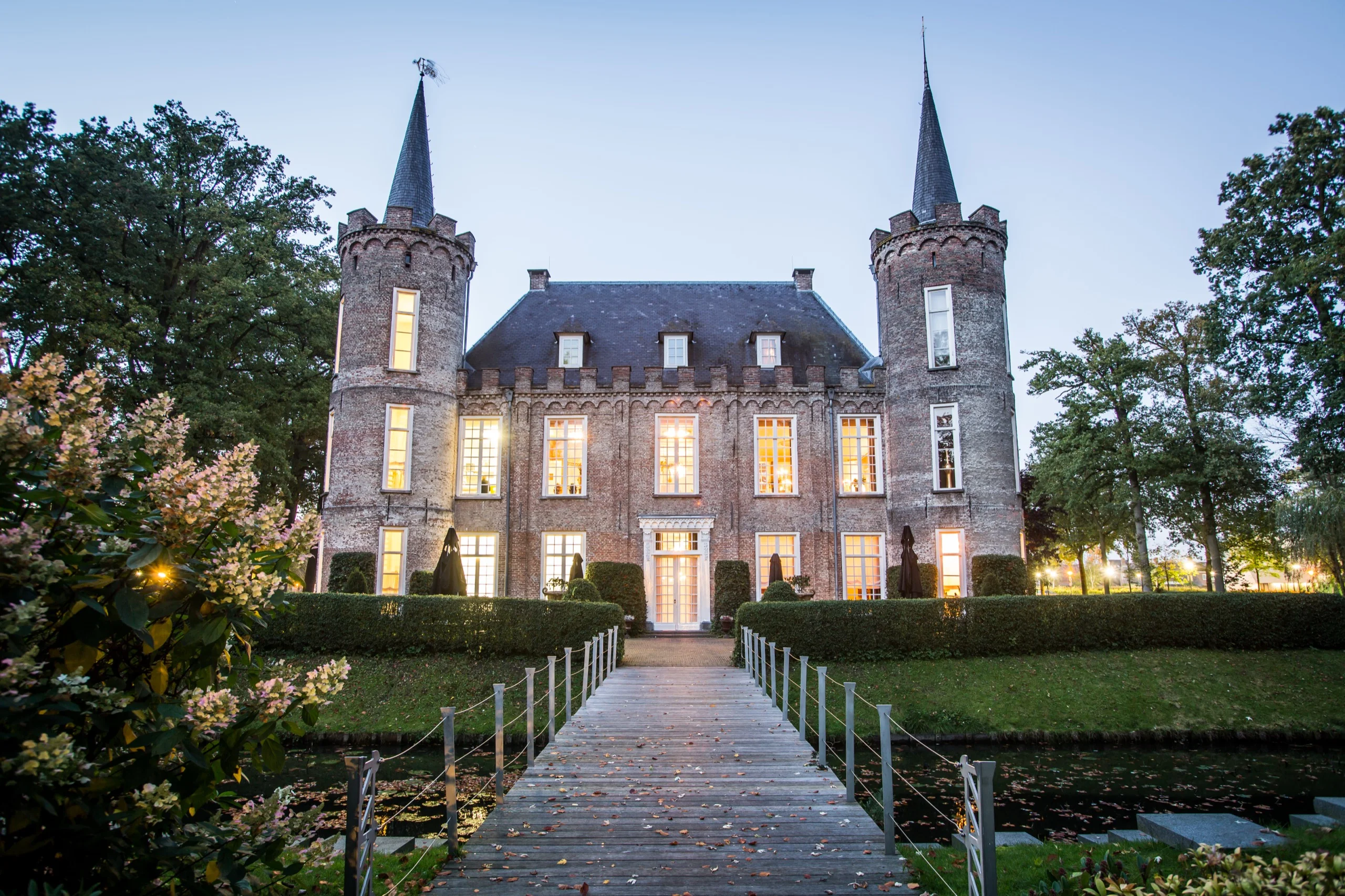
That matters even more at Kasteel Henkenshage. This is not a blank-canvas event hall on an industrial estate. It sits in a historic setting in Sint-Oedenrode. According to the national heritage register of the Cultural Heritage Agency of the Netherlands, Kasteel Henkenshage has been listed as a national monument since 19 September 1973. That gives the venue plenty of charm, but it also means the surroundings are less flexible than a hall with a large private car park right outside.
That is why La Casserole’s approach goes beyond food. Practical coordination around arrivals, suppliers, equipment, and guest flow is planned with the same care as dinner or drinks.
Practical tips:
- Add parking information to the invitation or guest app at least 2 to 3 weeks before the event.
- Mention clearly if guests may need a parking disc nearby.
- Reserve separate time slots in the run sheet for unloading, setup, and guest arrival.
- Appoint one contact person to handle parking questions on the day.
Why this matters
Parking at Kasteel Henkenshage is about more than spaces alone. It is the combination of route planning, available parking, blue zone rules, and supplier logistics around a historic event venue. If you only look at guest numbers, you will miss the real pressure points. What matters is when people arrive, how long they stay, and who needs to be closest to the entrance.
For a ceremony followed by dinner, guests often arrive within a 30 to 45 minute window. For an evening party, the pressure can build much faster, especially when daytime guests stay on and evening guests arrive at the same time. In practice, the difference between 80 daytime guests and 160 evening guests is not just twice the number of people. It creates a completely different traffic pattern.
The setting also calls for care and respect. Monumenten.nl, a platform of the Cultural Heritage Agency, describes Henkenshage as a moated medieval house with a beautiful park designed by architect Springer. A location like that is not suited to last-minute improvisation with vans, cocktail tables, and temporary storage in the wrong places.
That is why parking should come up in the very first venue meeting. It is not a side issue. It is part of hospitality. A relaxed welcome does not start with the first drink. It starts when guests know exactly where to go.
Step-by-step guide
A strong parking plan does not begin with finding the nearest available space. It starts with segmentation: who is arriving, when are they arriving, how long will they stay, and what kind of access do they need? La Casserole links those questions to catering, technical production, and rentals in the event plan, so setup never clashes with guest arrival.
Step 1: Build a guest profile for each arrival window
Split guests into daytime guests, evening guests, suppliers, and anyone who needs parking close to the entrance. At a wedding with around 60 to 90 daytime guests and later 120 to 180 evening guests, there are usually two clear peak moments. A full-service partner like La Casserole can line those up with the ceremony, drinks reception, dinner, and party schedule.
Step 2: Check the blue zone before invitations go out
Parts of central Sint-Oedenrode have parking restrictions. The municipality of Meierijstad states that in a blue zone you must use a parking disc, otherwise you may receive a fine. So do not just include an address in the invitation. Add a short note about local parking rules as well.
Step 3: Calculate realistic parking demand
As a rule of thumb, private events often see about 1 car per 2 to 3 guests, depending on age, travel time, and carpooling habits. For 150 guests, that usually means around 50 to 75 cars. La Casserole can use that estimate to decide whether extra signage, staggered arrivals, or shuttle transport would help.
Step 4: Keep supplier logistics separate from guest arrivals
A caterer, florist, technician, and rental company do not need parking in the same way your guests do. They need unloading access, sometimes multiple trips, and often 30 to 120 minutes for setup. In a La Casserole run sheet, those moments are coordinated with kitchen setup, furniture delivery, lighting, and sound.
Step 5: Keep route information short and mistake-free
Guests usually read parking instructions on their phones just before leaving. So keep it to no more than 5 lines: address, approach route, parking advice, blue zone note, and an emergency contact number. For couples who are still comparing providers, this also fits the wider benefit of wedding catering in Brabant with one clear partner.
Step 6: Set up a welcome point for the first 30 minutes
A parking plan only works if someone is there to manage it. For larger events, it is smart to have 1 host, master of ceremonies, or venue staff member available during the first arrival window. For full-service productions, La Casserole can coordinate this with service staff, the cloakroom, and the moment drinks are ready.
For example, imagine a couple expecting 80 daytime guests and 160 evening guests. If suppliers unload 90 minutes before the first guests arrive, and evening guests are asked to arrive 15 minutes later than the band, pressure at the entrance can drop noticeably. The result is not just a vague sense of calm. It means less waiting at reception and fewer phone calls to the master of ceremonies.
Practical tips:
- Create one parking rule for each group: daytime guests, evening guests, suppliers, and guests with limited mobility.
- For 100 guests, expect around 35 to 50 cars, unless a large number of guests are travelling together.
- Schedule suppliers at least 60 minutes before the main guest arrival peak.
- Test the route instructions on a phone and remove anything that is not essential.
Professional tips for parking at Kasteel Henkenshage
A parking plan works best when it fits the type of event. An intimate dinner for 40 people mainly needs clear directions. An evening party with a live band, food truck, or late arrivals usually needs active staggering. If you are considering a food truck, think beyond parking and include setup space and power requirements too. You can read more about that in this article on a food truck at your wedding in Brabant.
According to the Meierijstad Parking Plan, parking pressure in central Sint-Oedenrode can rise to as much as 64% in regulated areas during peak times such as busy shopping Saturdays. The same plan says that up to around 25% of drivers in the blue zone do not use a valid parking disc or exemption. Those are not wedding venue figures, but they do show why good communication matters.
| Approach | Best for | Preparation needed | Practical risk |
|---|---|---|---|
| Share the address only | Usually up to 30 guests | Around 5 minutes of text checking | 10 to 20 individual questions on the day if directions are unclear |
| Address plus parking instructions | Usually 30 to 100 guests | Around 30 minutes of coordination | Blue zone mistakes can still happen without a clear warning |
| Separate parking plan per guest group | Usually 100 to 180 guests | Around 1 to 2 hours of run sheet work | Less peak pressure, but communication needs to be tight |
| Shuttle or kiss-and-ride | Often from 180 guests upward, or with many older guests | Around 2 to 4 hours of planning | Extra cost, but much more control over arrival flow |
One professional tip: link parking to the event schedule. If guests stay after the ceremony for dinner, cars will be parked for much longer than at a 2 hour reception. And if the party finishes late, make sure taxis, pickup cars, and suppliers are not all trying to use the same access point at departure time.
Avoid common mistakes
The biggest mistake is assuming parking only becomes an issue on the day itself. By then, it is too late. Most parking problems start earlier, with an invitation that says nothing about parking discs, a run sheet with no unloading times, or a guest list that does not distinguish between daytime and evening guests.
A second mistake is treating suppliers like regular visitors. A rental company delivering furniture does not need a standard parking space. It needs short, permitted access for unloading. Around a historic venue, this matters even more, because works and alterations to a listed monument often require permits through the local authority, as explained by the Cultural Heritage Agency on works to national monuments. Temporary event setup is not the same as renovation, of course, but the same level of care helps avoid unnecessary hassle.
A third mistake is leaving bad weather planning too late. When it rains, guests want to be dropped off closer to the entrance, and suppliers often need more time to cover and protect equipment. This matters even more for outdoor celebrations, as La Casserole also explains in its practical guide to garden party catering and avoiding issues with power and weather.
Practical tips:
- Ask the master of ceremonies to review the parking instructions 1 week in advance as if they were a guest.
- Request number plates, arrival times, and unloading times from suppliers, usually in one shared run sheet.
- In wet weather, prepare a short drop-off route for older guests or guests wearing heels.
- After every programme change, check whether the parking plan still works.
Frequently asked questions
Where can I park at Kasteel Henkenshage?
Parking options depend on the time of day, the size of the group, and the local rules nearby. In most cases, it is best to give guests clear parking guidance and let them know about possible blue zones in Sint-Oedenrode. For events with around 100 guests or more, it makes sense to give separate instructions to daytime guests, evening guests, and suppliers.
Where is Kasteel Henkenshage located?
Location: Kasteel Henkenshage is located at Laan van Henkenshage 1 in Sint-Oedenrode, in the municipality of Meierijstad. The national heritage register lists this address for the monument. For navigation, it helps to include a short parking note as well, otherwise guests may simply follow directions to the front entrance without knowing where to leave the car.
Can you visit Kasteel Henkenshage?
Access is different from a typical public attraction. For a wedding or private event, entry, guest welcome, and parking should be arranged in advance through the organiser or venue planning. Guests should not assume they can simply turn up without a schedule, a reception time, or clear instructions.
When will the restoration of Kasteel Henkenshage begin?
Restoration planning mainly matters if works affect routes, vehicle access, or unloading spots. Because Kasteel Henkenshage is a listed national monument, any works are often linked to municipal permits and scheduling. If you are planning an event, always ask whether there will be site fencing, restricted access, or temporary walking routes around your date.
How does La Casserole help with parking at Kasteel Henkenshage in Sint-Oedenrode?
Coordination is where La Casserole adds value. The team links parking with catering, styling, technical production, rentals, and project management. For a wedding or private event, one run sheet can set out when suppliers unload, when guests arrive, and who is the contact person on site. That becomes especially useful from around 50 guests upward, when separate arrangements can quickly start to overlap.
Conclusion
Parking at Kasteel Henkenshage in Sint-Oedenrode is not a small practical detail. It affects first impressions, the couple’s peace of mind, and how smoothly suppliers can work. The core approach is simple: split guests into groups, check blue zone rules, schedule suppliers ahead of guests, and record everything in one run sheet.
That preparation is especially worthwhile at a historic venue. The setting is full of character, but it also demands tidy logistics. La Casserole is a strong fit here as a full-service partner, because catering, styling, technical production, rentals, and project management are planned as one joined-up operation. If you are organising a wedding or private event, it is smart to bring parking at Kasteel Henkenshage into the conversation from the very first venue meeting. That way, hospitality starts before guests even step inside.
Looking to host a stylish event in Brabant? Let us handle it!
Sources
- rijksmonumentenregister van de Rijksdienst voor het Cultureel Erfgoed — Monumentenregister
- fraai park naar ontwerp van architect Springer — Monumenten
- blauwe zone een parkeerschijf moet gebruiken — Meierijstad
- Parkeerplan Meierijstad — Lokaleregelgeving
- Laan van Henkenshage 1, 5492 BH te Sint-Oedenrode — Rijksdienst voor het Cultureel Erfgoed
- Henkenshage, Sint-Oedenrode — Monumenten.nl, Rijksdienst voor het Cultureel Erfgoed
- Parkeren in de blauwe zone — Gemeente Meierijstad