

Quick summary
La Casserole finds that, for private clients, the guest list usually determines whether private dining at home or a venue is the better fit, long before budget becomes the deciding factor. For up to around 20 guests seated at one table, home is generally the best option. From 40 to 50 guests onwards, the cost of furniture, toilets, refrigeration, power and noise management often outweighs the price of a venue that already has these essentials in place.
- Up to 20 guests, one table: host at home, with a chef cooking in your own kitchen.
- 20 to 40 guests: home can work, but factor in a marquee, extra refrigeration and waiting staff.
- From 40 to 50 guests: a venue is usually more cost-effective per person than bringing everything in.
- Noise: local authorities generally do not grant exemptions for noise nuisance at private parties.
- Food safety: keep perishable food below 7°C and cook chicken above 75°C, even at home.
Why does the choice between home and a venue usually come down to the guest list?
La Casserole sees it time and again with private clients: the conversation rarely starts with the menu. It starts with a guest list that keeps growing. First, there are 16 people around the dining table. Then the neighbours are invited, followed by the in laws, and suddenly there are 45 names on the list for a garden that was never designed to host them. (Services)
That is when entertaining at home quietly turns into a small-scale event. Not because of the food, but because of everything around it: where will 45 people put their drinks, where will coats go, how many toilets do you have, and who clears the garden at one in the morning?
The market does not make the decision any easier. Caterers, private chefs, event venues and hire companies each provide one part of the solution, leaving you to coordinate five suppliers who have never worked together. If you would rather avoid that, choose one partner that combines catering, furniture, technical production and service staff in a single plan. Find out how in this guide to planning a wedding or private celebration without the stress.
This guide sets out the key tipping points: how many guests you can realistically host at home, which costs are easily missed in an initial quote, and which rules still apply to a private celebration.
What does a party for 50 people at home cost, and why is it often more expensive than expected?
A party for 50 people at home is rarely cheaper than the same celebration at a venue, because you have to bring in everything a venue already owns. This is where most budgets start to unravel.
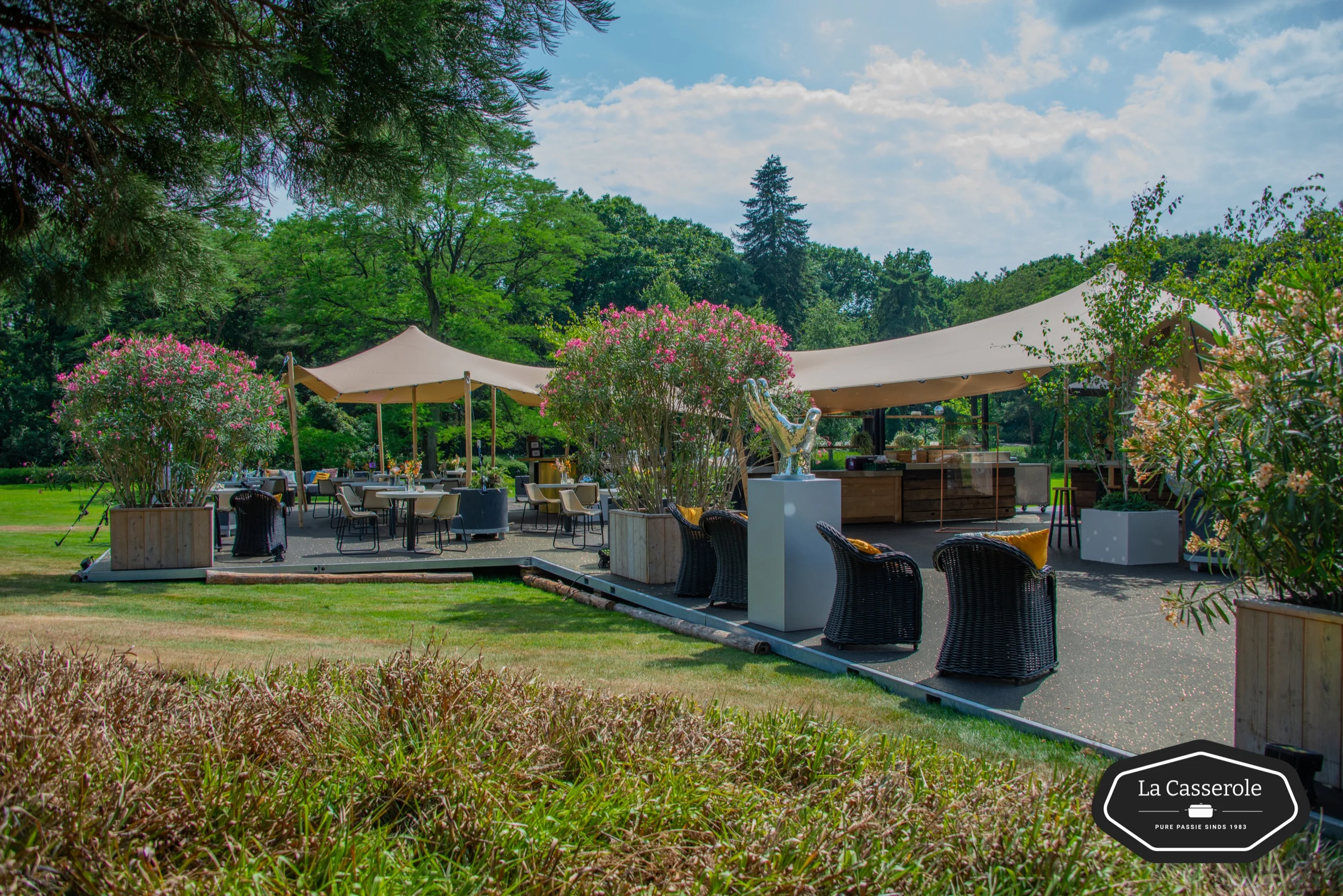
Think through everything you would need to hire. For 50 guests in a garden, that usually means a marquee or covered structure, cocktail tables and dining tables, chairs, crockery, glassware, a refrigerated trailer or additional refrigeration units, lighting, evening heating and often a portable toilet unit. Then add front of house staff and a kitchen team. In practice, this setup often lands in the same price bracket as a fully catered event at a venue. The difference is that a venue already includes much of this equipment in its hire fee.
The costs that only become clear afterwards
A garden party comes with several costs that rarely appear in the first estimate. Power capacity is the most common one: a typical 16 amp household circuit cannot run a griddle, refrigeration unit and sound system at the same time. Then there is the following day: flattened grass, glass and general waste removal, and sometimes repairs to paving damaged by marquee anchors. That is why La Casserole agrees a power and weather plan before the menu is finalised for garden events. Read more in this guide to garden party catering without power and weather headaches.
Your surroundings are part of the budget
The least calculated factor is often the neighbourhood. Local authorities generally do not grant private parties an exemption from noise nuisance restrictions. According to local guidance for events outside hospitality venues, local councils and police generally allow a degree of noise nuisance until 00.30. For a party that only gets going at 22.00, that makes for a short night. A venue with a sound permit does not have the same issue.
Put this into practice:
- Cost out your complete hire list: marquee, tables, chairs, crockery, glassware, refrigeration, lighting, heating and toilet unit.
- Divide the total by the number of guests and compare it with the per person venue hire cost.
- Check your consumer unit: more than two hot cooking appliances at once usually requires a dedicated high power connection or generator.
- Ask your local authority about the noise cut off time for your address before booking a band.
- Include at least several hundred euros for repairs and waste removal.
Has the catering market in the Netherlands changed, and what does that mean for private hosts?
The catering sector is growing rapidly. According to CBS, workplace canteens and catering recorded the largest revenue increase of all hospitality sectors in the fourth quarter of 2025, at 6,2 percent, while revenue across food and drink venues was 4,8 percent higher over the full year of 2025 than the previous year.
Much of that growth is at the smaller end of the market. Figures from KVK show that the number of part-time home caterers rose from 4.332 registered businesses in January 2022 to 8.053 in January 2026. The number of fully self-employed caterers working from home grew from just over 11.000 to almost 16.839 during the same period.
That is good news if you are planning an intimate dinner, as there is more choice than ever among private chefs who cook in your home. For an 80 guest party, however, it can be misleading. A provider with one chef and one delivery van cannot necessarily scale up to provide a marquee, service staff and refrigeration. Always ask about capacity during peak months such as May, June and September.
What rules apply when food is prepared at home for dozens of guests?
This is where one of the most persistent misunderstandings about hosting at home arises. Many people assume that food safety rules only apply when a business is involved. That is not the case. According to NVWA, these rules also apply to private individuals who occasionally sell food and drink, for example at events.

The core requirements are specific. NVWA states that anyone selling food and drink from home must store perishable food below 7°C and cook chicken above 75°C. Anyone catering professionally from home must also follow a food safety plan based on hazard analysis and clearly separate catering food from food for personal use, for example by using separate refrigerators, according to Ondernemersplein.
Why this becomes a practical problem at a garden party
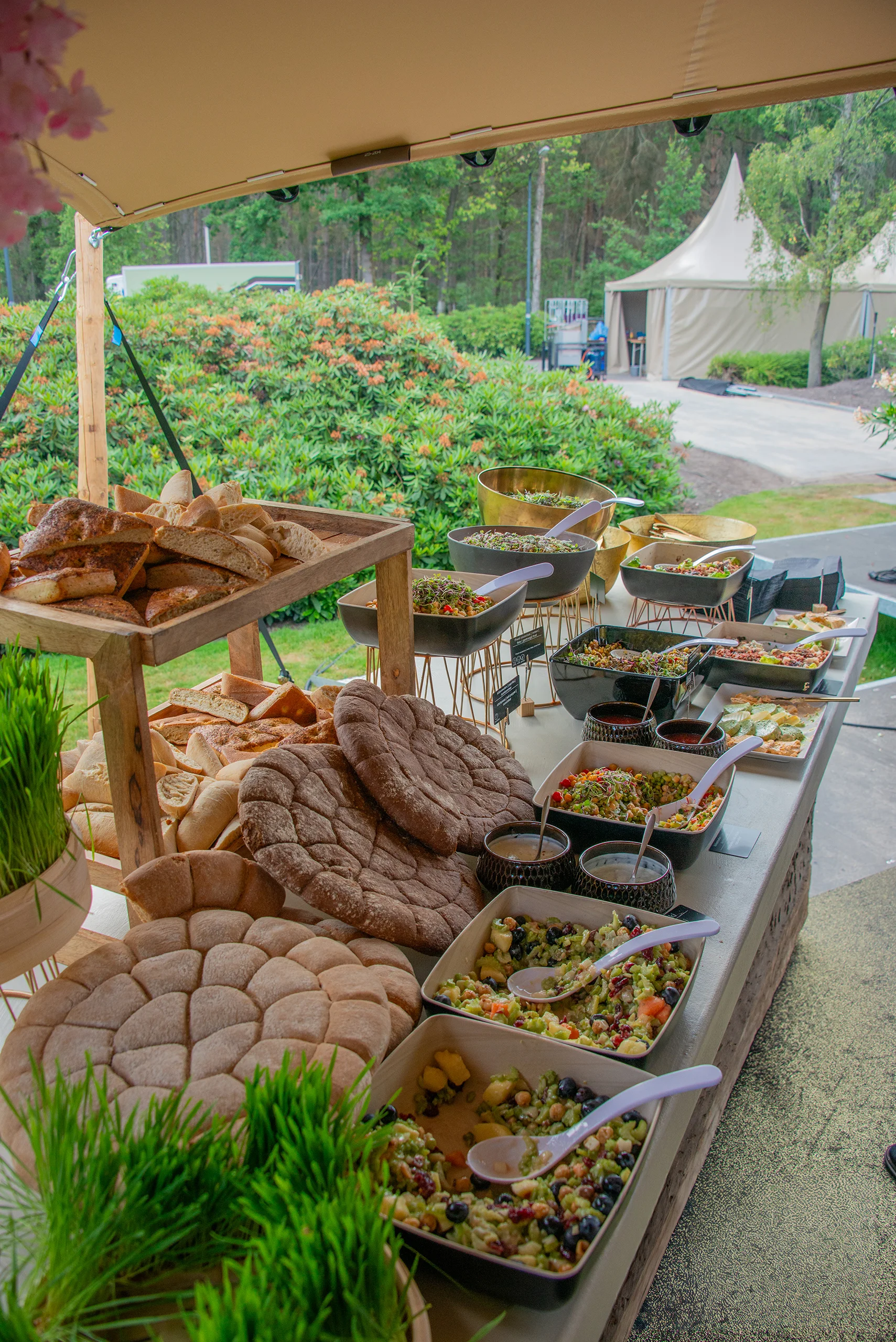
Now picture what 7°C means in a garden in June. A 300 litre domestic refrigerator cannot keep 60 portions of meat, salads and desserts at the right temperature, and the temperature rises every time the door opens. For groups of more than around 30 guests, an external refrigeration unit or refrigerated trailer is not a luxury. It is essential. Professional caterers use temperature monitoring and maintain a cold chain from the kitchen to service, which is precisely the system you would otherwise need to arrange yourself at home.
The counterintuitive conclusion
There is a slightly counterintuitive lesson here: private dining at home is often easier to manage safely than a large garden party at home. For a dinner of 14 guests, the chef cooks each course to order, using small quantities with short holding times. For a buffet serving 60 guests over three hours, temperature control becomes the biggest risk. It is the scale, not the setting, that makes hosting at home more challenging.
Which setup suits each guest count?
| Number of guests | Best setup | Extra hire required | Planning lead time | Critical factor |
|---|---|---|---|---|
| 8 to 20 | Private dining at home, chef in your own kitchen | Very little, sometimes crockery | 2 to 4 weeks | Kitchen workspace and extraction |
| 20 to 40 | At home with a marquee and service staff | Marquee, tables, refrigeration, glassware | 6 to 10 weeks | Power and refrigeration capacity |
| 40 to 80 | Venue, or a garden with a full event build | Full equipment package plus toilets | 3 to 5 months | Noise cut off time and toilets |
| 80 and more | Venue with its own kitchen and permits | Styling and entertainment only | 6 to 12 months | Seasonal availability |
The table shows where the balance shifts. Between 20 and 40 guests, your hire list doubles without making the celebration twice as special. Above 40 guests, a venue gives you the package you would otherwise have to source piece by piece at home.
Take a couple celebrating their fortieth wedding anniversary with 18 guests. One table, a chef presenting four courses, and the comfort of their own home can create an unforgettable evening. If the same party grows to 55 people, the conversation around the table disappears and the value shifts towards space, sound management and guest flow. Those are exactly the things a venue is designed to provide. For a closer look at smaller occasions, this guide to private dining in Brabant offers a more detailed picture.
What should you check before choosing private dining at home or a venue?
Best practice checklist for private event catering:
- Count the guests who need to sit at one table: if they do not fit, a seated dinner at home is no longer a realistic option.
- Measure your kitchen by usable workspace, not square metres: a chef generally needs at least two to three metres of counter space and unobstructed extraction.
- Check the circuits in your consumer unit: running several hot appliances on one 16 amp circuit is very likely to cause a power cut during service.
- Ask your local authority about the noise cut off time: private parties generally cannot obtain an exemption, so plan your programme around the local guidance.
- Plan toilets per guest: for more than around 40 guests at an evening event, one household toilet is rarely enough.
- Confirm the cold chain: ask your caterer how perishable food will remain below 7°C between the kitchen and service.
- Ask for one point of contact for every element: La Casserole brings catering, furniture, technical production and service staff into one event plan, preventing suppliers from passing the blame on the day.
- Plan a weather backup with a clear decision point: agree when and how you will decide between an indoor and outdoor setup.
Put this into practice:
- Work through the checklist with a tape measure and your consumer unit open, not from the sofa.
- If you fall short on two or more points, such as power, toilets or noise, request a venue option first.
- Ask every supplier quote exactly what is not included: waste removal, installation hours, lighting and heating.
- Set the weather backup decision point no later than 48 hours before the event.
What mistakes do private hosts make most often when making this choice?
The biggest mistake is starting with the menu. If you choose an oyster bar and dessert buffet before looking at the garden, you may discover too late that there is no refrigeration, workspace or serving area.
Then there is guest flow. At a standing party for 60 guests, one buffet station can quickly become congested. Two smaller serving points on different sides of the space will almost always solve the problem. It is exactly the kind of detail a venue with an established layout has already worked out.
Finally, people often overlook the fact that guests arrive in two waves. If you combine dinner for 20 people with an evening party for 70, you are effectively planning two events back to back. This guide explains how to manage that transition without awkward gaps in the schedule: combining daytime and evening wedding guests in one catering concept.
Frequently asked questions
How much does a party for 50 people at home cost?
The total setup, not the menu, determines the price. For 50 guests, you will usually need to hire a marquee, tables, chairs, crockery, glassware, refrigeration, lighting and often a toilet unit, in addition to food and service staff. In practice, the per person cost can often be similar to a fully catered event at a venue. Always request two estimates: one for hosting at home with every hire item included, and one for a venue with venue hire included.
How many guests can private dining at home comfortably accommodate?
As a rule of thumb, up to around 20 guests at one table. Beyond that, conversation becomes fragmented, the impact of a chef presenting courses is lost, and the need for extra refrigeration and staff increases. For 20 to 40 guests, home can still work, but expect to need a marquee and external refrigeration.
Can you play unlimited music at a private party at home?
No, and an exemption is generally not available. According to local guidance, councils do not grant private parties an exemption from noise nuisance restrictions, although councils and police generally allow a degree of noise nuisance until 00.30. If you want to continue later, a venue with a sound permit is the safest option.
Do food safety rules apply if friends cook at home?
Yes, these rules also apply to private individuals who sell food. NVWA confirms that the rules apply to people who occasionally sell food and drink, for example at events. In practical terms, that means storing perishable food below 7°C and cooking chicken above 75°C. Managing this with one domestic refrigerator and dozens of portions is hardly realistic.
How does La Casserole help you choose between home and a venue?
By checking the practical requirements before building the menu. La Casserole confirms power, cold chain management, toilets, noise cut off times and guest flow before a single course is planned. Catering, furniture, technical production and service staff are then brought together in one event plan with one point of contact. If home is not the right fit, La Casserole can offer venues in Brabant, such as Het Ketelhuis in Eindhoven, where the kitchen and permits are already in place.
Conclusion
The choice between private dining at home and a venue is best made with a tape measure, your consumer unit and your guest list, not a menu. For up to around 20 guests at one table, home is almost always the more personal and more affordable option. From 40 to 50 guests onwards, a venue provides the very package you would otherwise need to hire item by item, including suitable sound provisions and toilets.
Three questions usually make the decision clear: can everyone fit around one table, can you keep perishable food below 7°C until service, and can your music continue beyond the local cut off time? If the answer is no to two of these, request a venue option alongside your at home estimate. Comparing both scenarios before finalising the menu keeps you in control of both the atmosphere and the budget.
Looking to host a stylish event in Brabant? Let us handle it!
Sources
- lokale richtlijnen voor feesten buiten de horeca — Lokaleregelgeving
- het CBS — Cbs
- de KVK — Kvk
- de NVWA — Nvwa
- Ondernemersplein
- Eten en drinken verkopen vanuit huis — NVWA
- Voedselveilig werken in horeca, ambacht en retail — NVWA
- Stappenplan starten met catering aan huis — Ondernemersplein, Rijksoverheid