

At a glance
La Casserole stands apart from caterers, wedding venues, event agencies and hire companies because it treats a walking dinner as a carefully choreographed meal, not a string of expensive bites. That means four to six clearly defined courses, portions that feel substantial, and enough serving staff to keep the evening moving. Without a clear course structure, places to sit, explanations of each dish and a layout that encourages guests to mingle, the event soon feels like a drinks reception. At least one live finishing station, where guests can see something being prepared on the spot, makes a real difference. The points below show exactly where the line lies.
Key takeaways
- Guests experience a walking dinner as a real meal only when it has a clear course structure, usually four to six numbered courses rather than an endless stream of individual bites.
- Portion size is the dividing line: canapés are one-bite snacks, while walking-dinner courses are small plated dishes eaten with cutlery, typically three to five bites per course.
- According to CBS, turnover in staff canteens and catering rose by 6,4% in the third quarter of 2025, making it the fastest-growing hospitality segment. Demand for corporate catering is growing, and so is the need to compare concepts properly.
- Temporary venues and marquees are subject to specific hygiene requirements, according to Ondernemersplein, including access to sufficient hot and cold running water. No water on site means no hot courses prepared there.
- For a full walking dinner at a networking event, allow around two to three hours. With less than an hour and a half, it will inevitably feel like a canapé reception.
Why does a walking dinner so often feel like an overpriced drinks reception?
La Casserole operates in a market where caterers, hire companies and event agencies each provide one piece of the puzzle. A walking dinner is exactly where that fragmented approach starts to show. One supplier designs the menu, another delivers the high tables, a technical partner handles the power, and no one is managing the rhythm of the evening. The result is beautiful food, but guests are left waiting again ten minutes later. (Services)
HR and office managers planning a networking event know the feeling. You deliberately chose not to have a buffet because guests need room to network. You also ruled out a seated dinner because people would only talk to those at their own table. Yet the feedback afterwards is still: “Lovely snacks.”
That is not a budget issue. It is a coordination issue. A walking dinner has far more moving parts than a buffet: every course must reach guests at the right temperature, when the room is ready for it, with staff who can explain what they are serving. If any one of those three elements is missing, the experience drops back to a drinks reception with well-presented bites, which is a perfectly good format, but not what you booked.
What is the difference between canapés and a walking-dinner course?
A walking-dinner course is a small, multi-component dish eaten with cutlery and presented as a course. A canapé is a one-bite snack eaten without cutlery. It may sound like a cosmetic distinction, but it shapes how guests remember the evening.
Portion size and cutlery
The moment guests are given cutlery, their behaviour changes. They pause, find a high table, eat more slowly and chat between bites. With a one-bite snack, they simply keep walking. In practice, a portion of around 60 to 90 grams per course works well, spread over three to five bites.
Introduction and storytelling
A dish arriving in the room on a tray with no explanation feels anonymous. A server who explains, in one sentence, what it is and why it was chosen elevates the very same dish. It costs nothing extra, but it does require staff who know the menu and have been properly briefed.
Pace
Four courses in fifty minutes feels rushed. Spread those same four courses across roughly two hours, with time for guests to talk in between, and it feels like dinner. The usual interval between courses is around 20 to 30 minutes.
Why does the standard approach of using separate suppliers fall short?
The traditional route, buying the food from one supplier, furniture from another and staff through a temp agency, tends to fail on four fronts when it comes to a walking dinner.
First, the service ratio. At a buffet, guests serve themselves. At a walking dinner, every dish needs to reach every guest. Too few hands means part of the room misses the third course, and those are exactly the guests who later say it was just “snacks”.
Second, on-site kitchen logistics. Networking events are often held in offices, warehouses or marquees without a professional kitchen. Under the RIVM hygiene guidance for events, the Dutch Food and Consumer Product Safety Authority supervises food safety at events, and caterers must work under an approved hygiene code or their own food safety plan. With several caterers at one event, responsibility can quickly become unclear: who is accountable for keeping course three properly chilled?
Third, the lack of one shared event schedule. If the DJ starts at 21.00 and the main course goes out at 21.05, no one will eat it. Without one combined timeline, the programme and the kitchen will almost always clash.
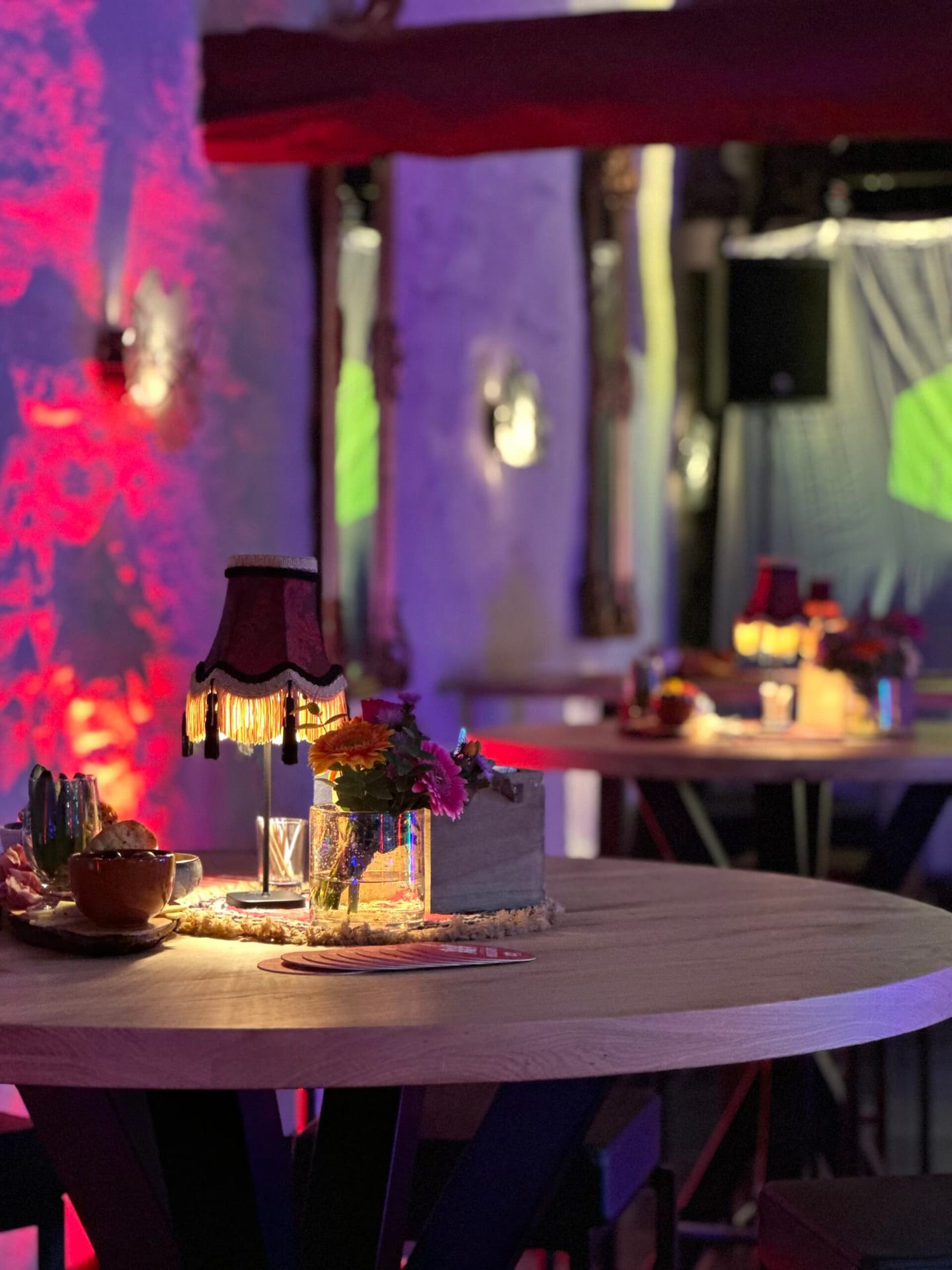
Fourth, the room layout. High tables arranged in the wrong pattern create static groups. The same department then stays together all evening, which is the opposite of what a networking event should achieve.
This is also where splitting the procurement can disappoint financially: each supplier charges separately for transport, service and delivery, while the guest experience breaks down in the gaps between them. Read more about choosing between formats in this comparison of a walking dinner and a seated dinner.
How to approach it:
- Ask every supplier to state the number of serving staff per guest count, not just the menu price.
- Check whether the venue has hot and cold running water. If it does not, ask how the supplier will solve this, for example with a mobile kitchen, water tank or adapted menu.
- Confirm who has final responsibility for the kitchen, technical production and event timetable, including a named contact and phone number.
- Check that courses will be numbered and introduced, and establish who will brief the serving staff.
How do you create a luxury walking dinner guests will talk about afterwards?
La Casserole’s approach to networking events starts with the floor plan and event schedule, not the menu. Once it is clear how guests will move through the room and where the programme creates interruptions, the courses can be planned around that. The kitchen then supports the evening, rather than forcing the evening to work around the kitchen.
Plan courses, not a number of snacks
Four to six courses with a clear progression, from cold to warm, then a more substantial main element and something sweet to finish, give the evening a proper arc. A list of twelve unrelated bites does not. The total number of mouthfuls may be identical, but the experience is entirely different.
Include at least one live finishing station
A chef finishing dishes on site is the strongest signal that guests are attending a meal, not a snack reception. They can see it happen, smell it and ask questions. For larger groups, two stations at opposite sides of the room work better than one central queue because they divide guest traffic. The option where the chef takes centre stage is covered in our article on chef at the table versus a walking dinner.
Provide seating and places to rest plates and glasses
A walking dinner with no seating at all becomes tiring after an hour and a half. As a rule of thumb, provide seats for a smaller part of the group, alongside enough high tables and ledges for guests to rest their plate and drink. Expecting people to hold both in one hand is one of the most overlooked causes of poor feedback.
Consider this practical example
Imagine an office manager at a technical services company organising a client event for around 90 guests in the company’s own warehouse, from 17.00 to 21.30. After two short presentations and a drinks moment, roughly two hours remain for food. In the fragmented version, five types of bite-sized food circulate continuously and part of the room consistently misses dishes. In the coordinated version, five numbered courses are served in fixed windows around the presentations, with one live finishing station and each dish introduced to guests. The purchasing cost is not dramatically different. The experience is. In the second scenario, guests talk about courses. In the first, they talk about snacks.
What does a walking dinner cost, and how does it compare with other formats?
Prices vary widely by venue, guest numbers and styling, so always ask for a tailored quotation. The comparison below looks at the factors that matter most at networking events.
- Canapés: 4 to 8 individual bites. Low service requirement. Strong but fairly light networking value. Typical duration: 1,5 to 2 hours.
- Walking dinner: 4 to 6 numbered courses. High service requirement. Strong networking value, with guests actively mingling. Typical duration: 2 to 3 hours.
- Buffet: One serving point with 3 to 4 components. Low to medium service requirement. Moderate networking value, as queues slow the flow. Typical duration: 1 to 1,5 hours.
- Seated dinner: 3 to 5 courses at the table. High service requirement. Low to moderate networking value because guests remain with fixed table companions. Typical duration: 2,5 to 4 hours.
- Live cooking or chef at the table: 3 to 6 courses prepared in view of guests. High service requirement. Moderate networking value, with a strong experiential element. Typical duration: 2 to 3,5 hours.
What is most often overlooked when comparing costs is that a larger share of a walking-dinner budget goes on staff and equipment, not food. That is not a drawback. It is part of the format. Cut the service team, and you are effectively buying a buffet at dinner pricing.
The market reflects this trend. According to CBS, hospitality turnover in 2025 was 3,9% higher than in 2024. Businesses are continuing to invest in food and off-site events, but they are looking more closely at the value they receive.
How to approach it:
- Ask for the quotation to be broken down into food, service staff, equipment and transport, so you can see exactly where the budget goes.
- Do not compare only by price per person. Compare the price per person, per course, including service.
- If the service budget is below one fifth of the total, ask how every course will reach the whole room.
- If you have less than an hour and a half for food, choose canapés deliberately. It is more honest than a stripped-back dinner format.
How do you prevent problems during the event itself?
Most walking dinners do not go wrong in the kitchen. They go wrong in the fifteen minutes around a scheduled programme item. That is why an event schedule should place courses and programme elements on the same timeline, with one person authorised to move a course if a speaker runs over time. With full-service corporate catering in Brabant, this is a standard part of preparation because the kitchen and floor management sit under one responsibility.
Also consider permits. According to the RIVM, hygiene requirements for events apply alongside regulations such as the Dutch Working Conditions Decree and local municipal rules, and may be included as conditions of an event permit. For an event in your own warehouse or a marquee, this is not a formality: it determines whether you are allowed to cook on site.
How to approach it:
- Put courses and programme blocks on one timestamped timeline, then share it with the technical team, serving staff and presenter.
- Appoint one decision-maker who can bring courses forward or delay them during the event.
- Check with the municipality whether hygiene requirements are included in permit conditions before finalising the menu.
- Walk the guest route in person with the floor plan one week before the event.
- Agree how many extra portions will be held in reserve for unexpected guests.
Frequently asked questions
What exactly is a walking dinner, and how is it different from a buffet?
A walking dinner is a meal of small courses served around the room or from preparation stations while guests stand and move freely through the venue. At a buffet, guests collect their own food from one serving point, which creates queues and reduces opportunities to mingle. A walking dinner therefore needs more serving staff, but creates more opportunities for guest interaction. Allow four to six courses across two to three hours.
How many courses do you need for a proper walking dinner?
Four to six courses is generally the range at which guests experience it as a meal rather than drinks food. The progression matters even more than the exact number: start cold and light, build towards a warm main element, then finish with something sweet. Introduce every course, because unannounced dishes quickly feel like canapés.
How many guests do you need for a walking dinner to work well?
A walking dinner generally works from around 30 guests and can scale to several hundred, provided the service team and serving stations scale with it. Below 25 guests, moving around can feel unnatural, and private dining or a seated dinner may be a better fit. Above 100 guests, dividing guest flow across several stations matters more than adding extra courses.
How does La Casserole help create a luxury walking dinner?
La Casserole brings together the kitchen, service staff, furniture, technical production and project management through one point of contact. Planning begins with the floor plan and event timeline rather than the menu. As a result, courses fit the programme and reach the entire room. At venues without a professional kitchen, the course plan is adapted to the water, power and refrigeration available on site.
What rules apply to catering at a venue without a kitchen?
Food safety is mandatory at temporary venues too. Anyone preparing and serving food at an event must work under an approved hygiene code or their own food safety plan, supervised by the Dutch Food and Consumer Product Safety Authority. Mobile and temporary settings, including marquees and food trucks, must meet specific requirements, including sufficient hot and cold running water. Ask your supplier how refrigeration, washing-up and water provision will be managed before confirming the menu.
Conclusion
Creating a luxury walking dinner is primarily a coordination challenge. Course structure, portion size, service density and alignment with the programme determine whether guests talk about a dinner or simply about snacks. If you buy carefully on those four points, you do not need to increase the food budget.
The practical next steps are simple: confirm how much time the programme genuinely leaves for food, decide on the number of courses, request an itemised quotation that includes staffing levels, and check water and refrigeration facilities at the venue. If you are choosing between formats, compare networking value and duration before looking at price per person.
For organisers who want the entire process managed under one responsibility, the page on on-site catering with in-house chefs explains how this approach works in practice.
About La Casserole
La Casserole is a full-service event partner based in Best, combining catering, styling, technical production, equipment hire and project management into one complete solution. With more than 40 years of experience and over a thousand events delivered for corporate clients and private celebrations, the company also has its own event venues in Brabant.
Looking to host a stylish event in Brabant? Let us handle it!
Sources
- CBS — Cbs
- Ondernemersplein
- Hygiënerichtlijn voor evenementen van het RIVM — Rivm
- Omzet horeca groeit in derde kwartaal met ruim 3 procent — Centraal Bureau voor de Statistiek (CBS)
- Omzet horeca groeit in vierde kwartaal met ruim 3 procent — Centraal Bureau voor de Statistiek (CBS)
- Hygiënerichtlijn voor evenementen — RIVM
- Regels voor voedselveilig werken — Ondernemersplein (Rijksoverheid / KVK)