

Quick summary
Garden party catering at a business premises or company site can be derailed by three hidden risks: not enough power capacity, no weather backup plan, and weak outdoor food safety procedures. If you deal with those three areas properly in advance, you won’t be firefighting on the day itself.
- Calculate the peak load of all equipment and, as a rule, allow a 20 to 30 percent buffer above that figure as the minimum capacity for your generator.
- Temporary electrical installations at outdoor events fall under NEN 8020-20 and must be inspected before they are put into use.
- According to KNMI climate scenarios, the Netherlands is seeing more intense summer downpours and fewer light showers, which means weather patterns are becoming more unpredictable, not gentler.
- Any caterer selling food at an event must register its activities with the NVWA and work with a HACCP food safety plan.
- One point of contact covering catering, marquee hire, technical setup, and power planning can act much faster than three separate suppliers.
Why corporate garden party catering is more complicated than it looks
Picture this: an HR manager at a mid-sized manufacturing company is organising a summer staff event for 80 employees on the company grounds. The menu is sorted, a supplier has been chosen, and the date is locked in. What’s missing from the checklist? How much power the catering team will actually need, what happens to refrigeration if temperatures hit 28 degrees, and what the fallback plan is if a thunderstorm rolls in at 2:00 pm. (Services)

These are exactly the things that most often go wrong at corporate garden events. Not the food itself, but everything around it. La Casserole sees this pattern in almost every first enquiry for outdoor corporate catering: clients have thought carefully about the menu and guest experience, but the technical and logistical side hasn’t had the same attention. That’s understandable, because those details only become visible when something goes wrong.
A Dutch summer comes with very few guarantees. According to the Royal Netherlands Meteorological Institute (KNMI), heavy showers with extreme rainfall are becoming more common, while lighter summer showers are declining. That means planning based on averages is no longer enough. A weather plan isn’t a nice extra; it’s essential. And if you want complete event support, from catering to marquee and technical setup, you also save yourself from spending the day juggling separate suppliers.
Understanding the problem: the four points where things usually go wrong
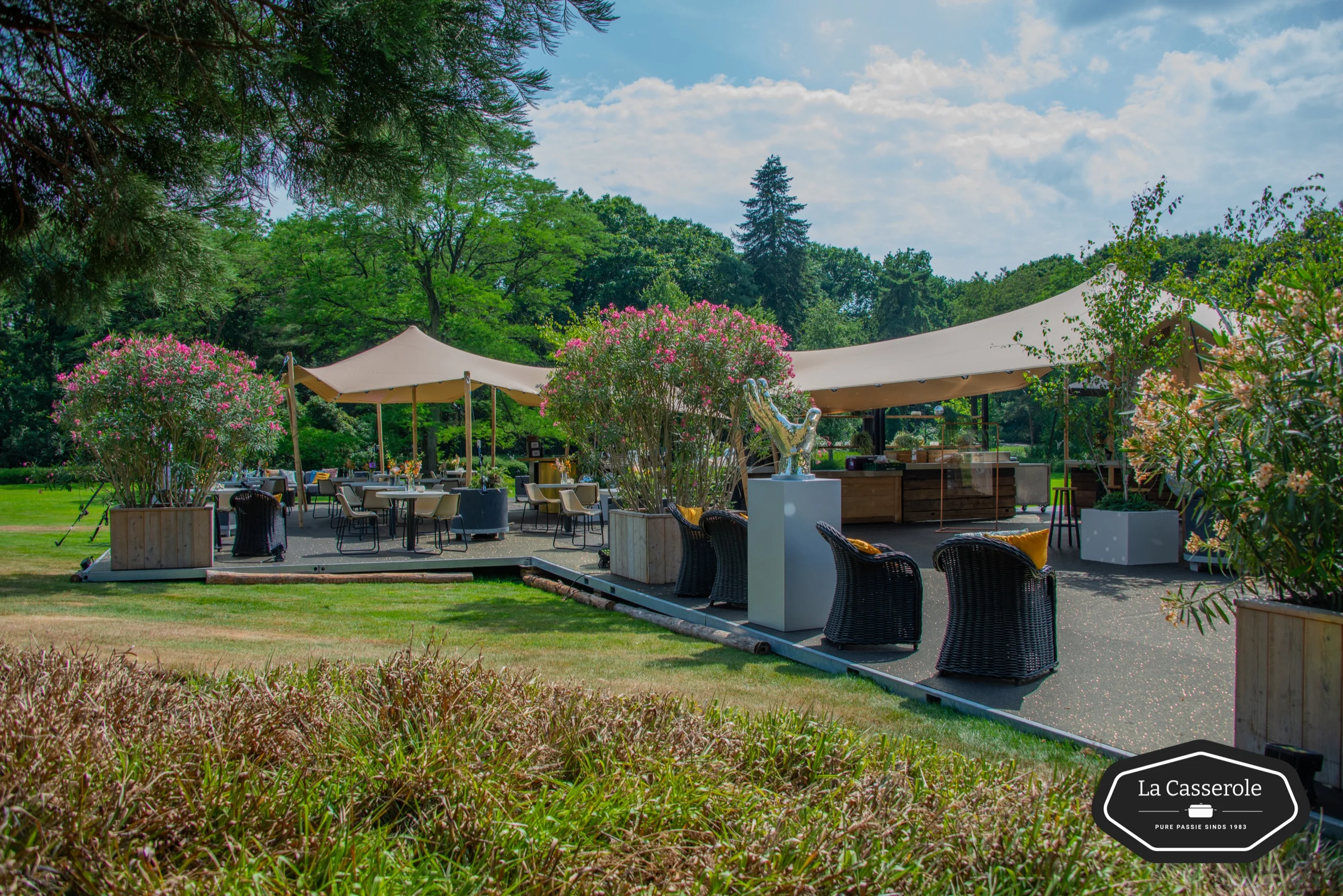
Outdoor garden party catering needs a different approach from catering in a hall or under a fixed roof. The same four pressure points come up again and again:
Power capacity gets underestimated
Professional kitchen equipment uses a lot of electricity. A commercial espresso machine, induction hob, refrigeration unit, and lighting can easily add up to several kilowatts of peak demand. In practice, actual power use often turns out to be higher than expected, because clients don’t always know exactly what equipment the caterer is bringing. A pizza oven that looks fairly compact can draw more power than five standard wall sockets combined.
At outdoor venues, access to the building’s permanent power supply is often limited or not available at all. If you arrange a generator without properly calculating the load, you risk a power cut at exactly the moment the hot course is due to be served.
Legal standards for temporary installations are ignored
For temporary electrical installations at outdoor events, NEN 8020-20 is the specific applicable standard; NEN 3140 and NEN 1010 also apply. Generators must be fitted with residual current devices: for generators up to 32A, a 30 mA version is required; for generators above 32A, a 300 mA version is required. Temporary installations must also be inspected before use. Skip that step and you are not just operating unsafely, you may also be left exposed if something goes wrong.
No realistic weather plan
The most common mistake when planning a summer garden party is simply hoping for dry weather and making no real backup arrangements. The biggest mistake is assuming it will probably stay dry and leaving it at that. In the spring of 2024, many hospitality businesses saw revenue literally washed away by extreme rainfall in April and May, according to FoodService Instituut Nederland via MarketingTribune. A realistic weather plan means discussing a marquee or covered structure when the event is booked, not treating it as a last-minute add-on.
Food safety outdoors is more complex than indoors
Cooling, hygiene, and temperature control become more challenging outside. Any business selling food and drink to consumers, including at events, must register with the NVWA and work with a food safety plan based on HACCP. Once temperatures climb above 25 degrees, cold dishes and chilled supply chains become especially vulnerable.
What you can do yourself:
- Ask the caterer for a full list of equipment, including wattage and connection type (Schuko, CEE 16A, or CEE 32A).
- Add up the total peak load and include a 20 to 30 percent safety margin.
- Check whether the temporary installation has been inspected under NEN 8020-20 before use.
- Ask specifically for the HACCP plan for outdoor service, including how chilled food will be managed in warm conditions.
Why the traditional approach falls short
The standard way to organise garden party catering is to hire a caterer, a marquee supplier, a generator company, and sometimes a separate electrical technician, all individually. On paper, that sounds workable. In reality, it creates three basic problems.
Coordination between separate suppliers takes time and causes mistakes
If the marquee supplier doesn’t know how much power the caterer needs, and the generator supplier doesn’t know how many connections the marquee setup requires, a responsibility gap appears. Nobody is clearly in charge of closing it. The client, usually an office manager or HR manager with plenty of other responsibilities, becomes the unwilling coordinator. That often leads to miscommunication and last-minute fixes.
Weather planning is not connected to catering operations
A marquee supplier can advise on shelter and structures, but won’t usually think through what a weather shift means for the order of service, the position of hot holding equipment, or guest flow between the tent and service stations. Linking weather scenarios to catering logistics only really works when both sit under one lead supplier.
Compliance gets spread across nobody’s job description
If the electrical technician is responsible for the installation, but the caterer brings equipment without proper coordination, there is a real chance that no one calculates the total load as a whole. In practice, actual power use often turns out to be higher than expected, which leads to overload and failure.
A comparison: separate suppliers versus an integrated approach
| Criterion | Separate suppliers | Integrated approach |
|---|---|---|
| Coordination workload for the client | High (3-5 contacts) | Low (1 contact) |
| Power plan calculated in advance | Rarely, and usually per supplier | Yes, as part of the full event plan |
| Weather plan linked to catering | No | Yes, built into the operating plan |
| NEN inspection arranged | Depends on the supplier | Included as part of the standard service |
| Response time to last-minute weather changes | Usually slow (consultation required) | Fast (one decision-maker) |
| Costs if power fails or equipment goes down | Disputed between suppliers | One party is accountable |
What you can do yourself:
- Count how many suppliers you would need to contact right now for a fully managed garden party. If it’s more than two, your coordination risk is already real.
- Ask every supplier quote the same direct question: who has final responsibility for on-site power distribution?
- Check whether the weather plan is specific (marquee yes/no, heaters yes/no) or just vague reassurance.
A better approach: how to solve power and weather issues properly
The most effective method used by experienced event teams, and the one La Casserole applies systematically to outdoor corporate catering, is integrated preparation across three stages: a power audit, a weather scenario plan, and an outdoor food safety protocol.
Stage 1: the power audit
For every garden party, La Casserole creates a full overview of all equipment brought by the catering team, including wattage per item and connection type. The total peak load determines the generator capacity required. On top of that, a 20 to 30 percent buffer is built in so the system never operates at its limit. Power is then distributed by zone: catering, lighting, and sound each have their own circuit, so a problem in one zone doesn’t bring down the others. This kind of zoned distribution is one of the most effective ways to prevent cascading failures.
Just as important, all installations must comply with NEN 8020-20, and generators must be fitted with the legally required residual current devices. Inspection before use is not optional; it is mandatory.
Stage 2: the weather scenario plan
Based on KNMI climate data, Dutch summer weather has become more unpredictable in recent years. Heavy downpours arrive more suddenly, while dry spells last longer. KNMI summer data for 2025 shows that the Eindhoven weather station was the driest automatic KNMI station that year, with just 100 mm of rain, while on 7 days somewhere in the Netherlands at least 50 mm fell. That shows how local weather extremes can be, even in an otherwise dry summer.
A strong weather scenario plan includes three worked-out versions: dry and warm, cloudy with a chance of showers, and persistent rain. For each version, the catering layout, guest positioning, and the tent or cover to be used are all clearly defined. The marquee size should be based on the worst-case scenario, not average conditions.
Stage 3: food safety in an outdoor setup
Outdoor catering places higher demands on chilled food management. La Casserole works with a HACCP plan that specifically takes outdoor temperatures into account, because sun and heat significantly reduce the safe holding time of cold dishes. In warm weather, cold dishes are served later and refrigeration units are used with a built-in capacity buffer. NVWA registration and an approved food safety plan are basic requirements that any professional caterer should always meet.
If you want to explore how full-service catering for corporate events reduces the overall coordination burden, you’ll find a clear explanation there of the value of having one lead contact.
What you can do yourself:
- When booking, ask for the power overview and weather scenario plan as actual documents, not verbal promises.
- Check whether the marquee in the weather plan can also function as the standard catering setup, not just as an emergency fallback.
- Ask whether the HACCP plan has been adapted for outdoor use, not just for kitchen preparation.
- Put this question on the table: if the weather changes at 1:00 pm, who calls whom? Is there one person with the authority to make decisions?
Planning tips: how to organise garden party catering in practice
Practical planning for garden party catering usually starts four to six weeks before the event, and earlier for popular summer dates. The process La Casserole uses for outdoor corporate catering is also useful for clients managing several suppliers themselves.
Timing and booking window
Popular dates in May, June, and September tend to fill up early with specialist caterers. If you book in April for a June event, you’ll usually have a wider choice of menus, formats, and service options. If you book in May for June, you’re often working around what’s left. Booking early is the smart move, especially for spring and summer events.
A site visit is not a formality
A pre-event site visit, where the exact location of power connections, the distance from terrace to kitchen, and the condition of the ground are all mapped out, prevents surprises on the day. Issues like cable runs, uneven surfaces for kitchen equipment, or lack of shade can be spotted in ten minutes on site, but they are much harder to solve once guests have arrived. La Casserole includes a location check as a standard part of preparation for corporate garden events.
BBQ, buffet, or walking dinner outdoors
The catering format directly affects how much power you need and how exposed the setup is to wind and rain. BBQ catering on location usually requires less electrical capacity but more attention to wind direction and smoke nuisance. A walking dinner with hot dishes needs more hot holding infrastructure and is more vulnerable to cooler evening temperatures. A cold buffet is generally the most weather-resilient option, but it requires stricter chilled food monitoring in warm conditions.
If you’d like a closer look at how the catering format should match the atmosphere and goal of the event, you’ll find a more detailed comparison in the article on organising a company party without stress.
What you can do yourself:
- Schedule the site visit at least three weeks before the event, not one week before.
- During the visit, review three things: the position of fixed power connections, the cable route to the catering area, and the guest escape route in bad weather.
- Choose the catering format partly on weather resilience: a cold buffet performs best in uncertain weather, while a walking dinner with hot dishes is the most vulnerable.
- Ask the caterer whether there will be an on-site contact person with the authority to adapt the plan during the event.
Frequently asked questions
How much power does a professional caterer need for a garden party?
Peak load depends on the menu style and kitchen equipment, but for a garden party with hot dishes for 50 to 100 guests, total consumption across catering equipment, lighting, and refrigeration is usually significant. Add up the wattage of every item and use a 20 to 30 percent safety margin above peak demand as a rule of thumb. Always ask the caterer for a full equipment list with power ratings and connection types before arranging a generator.
What standards apply to temporary power supplies at an outdoor event?
NEN 8020-20 is the specific standard for temporary electrical installations at events; NEN 3140 and NEN 1010 also apply to generators and associated installations. Generators must be fitted with residual current devices, and temporary installations must be inspected before use. If you skip this, you risk not only equipment failure but also liability if an incident occurs.
What should you do if the weather turns during a catered garden party?
A clear weather scenario plan is what stops you from having to improvise on the day. The plan should include at least three versions: dry weather, light showers, and prolonged rain. For each version, it should specify a catering layout, guest route, and the tent or covered structure to be used. For corporate garden events, La Casserole works with this type of plan as standard, with marquee size based on the worst-case weather scenario rather than the average forecast.
How does La Casserole help plan outdoor corporate catering in the Eindhoven area?
La Casserole operates as a full-service event partner from Best, providing complete catering, marquee setup, power planning, and food safety protocols for garden events in Brabant and the Eindhoven region. With more than 40 years of experience and over a thousand events delivered, the power audit, weather scenario plan, and HACCP protocol are standard parts of the preparation process. That means one point of contact with decision-making authority on the day if the weather changes.
Does a caterer serving outdoors need NVWA registration?
NVWA registration is mandatory for any business selling food and drink to consumers, including at events and private garden parties. The caterer must also work with a food safety plan based on HACCP. When booking, always ask for confirmation of that registration and request the HACCP plan, especially for corporate events where your company is hosting staff or business relations.
Conclusion
Garden party catering for corporate events requires more disciplined preparation than most clients expect. Power failure, a sudden downpour, and chilled food problems in hot weather are not bad luck. They are usually the result of missing planning. If you work through the three stages properly — power audit, weather scenario plan, and an outdoor HACCP protocol — and make sure one party has final responsibility, you remove the biggest risks.
The approach La Casserole uses for outdoor corporate catering shows that this doesn’t have to be complicated. It starts with one point of contact managing catering, marquee, technical setup, and compliance as one joined-up package. Want to see what that looks like in practice for a summer business event in Brabant? Explore the full range of off-site catering services in the Eindhoven region.
Looking to host a stylish event in Brabant? Let us handle it!
Sources
- NEN 8020-20 — Sbkopleidingen
- KNMI-klimaatscenario’s — Knmi
- In de praktijk blijkt het verbruik vaak hoger dan vooraf opgegeven — Vanlieshoutelektra
- De grootste fout is hopen dat het wel droog blijft en verder niets regelen — Pijske
- FoodService Instituut Nederland via MarketingTribune — Marketingtribune
- Iedere ondernemer die eten en drinken verkoopt aan consumenten, ook op evenementen, moet zich registreren bij de NVWA — Nvwa
- Zo veranderen weerextremen in Nederland — Koninklijk Nederlands Meteorologisch Instituut (KNMI)
- KNMI – Zomer 2025 — Koninklijk Nederlands Meteorologisch Instituut (KNMI)