

The short answer
At La Casserole, we start by assessing the practical basics for garden parties of 40 to 80 guests. If you have a level, hard surface, easy vehicle access and neighbours who are happy with the plan, catering at home is often the better option. But as soon as you need a marquee, flooring, portable toilets and a generator, the budget can quickly match that of a hired party venue. At that point, the venue usually wins on comfort and peace of mind. Since 1 January 2024, marquees and other temporary structures fall under the Besluit bouwwerken leefomgeving, alongside local APV rules. Always check with your local council whether a notification is sufficient or whether you need a permit.
Key takeaways
- According to Ondernemersplein (Dutch Government), some events require a council permit, while others only need to be reported. The rules vary by municipality and can be found on your council’s website or on Lokaleregelgeving.nl.
- A notification and a permit are different processes. A notification is simply advance notice and is usually handled quickly. A permit requires an assessment and can take several weeks or months.
- Local councils often use noise limits of 50 dB(A) during the day, 45 dB(A) in the evening and 40 dB(A) at night, measured at the façade of the nearest home, as set out in local regulations on Overheid.nl.
- Any supplier preparing food on site must work with a HACCP food safety plan or approved hygiene code, according to the NVWA. Ask about this directly.
- The tipping point is not the guest count. It is how much infrastructure you need to hire: a marquee, flooring, toilets, generator and refrigeration.
Why does a garden party seem cheaper than it really is?
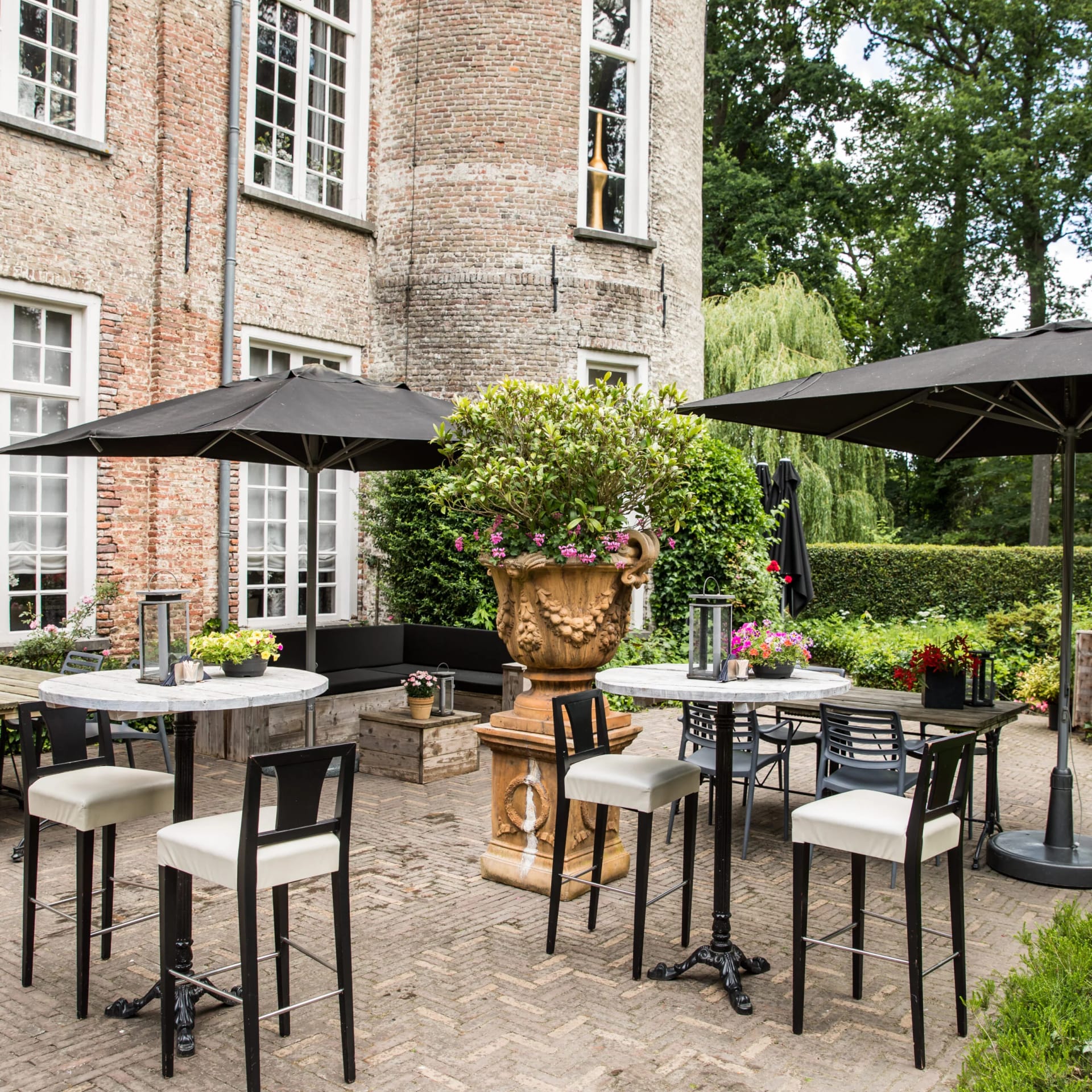
La Casserole often sees private clients start the garden versus venue comparison in the wrong place. They compare venue hire with the per person cost of party catering, then assume hosting at home will be cheaper. In reality, that calculation rarely holds up. A venue hire fee typically includes a kitchen, electricity, toilets, heating, flooring and washing-up facilities. In your garden, you may need to source every one of those elements separately. (Services)
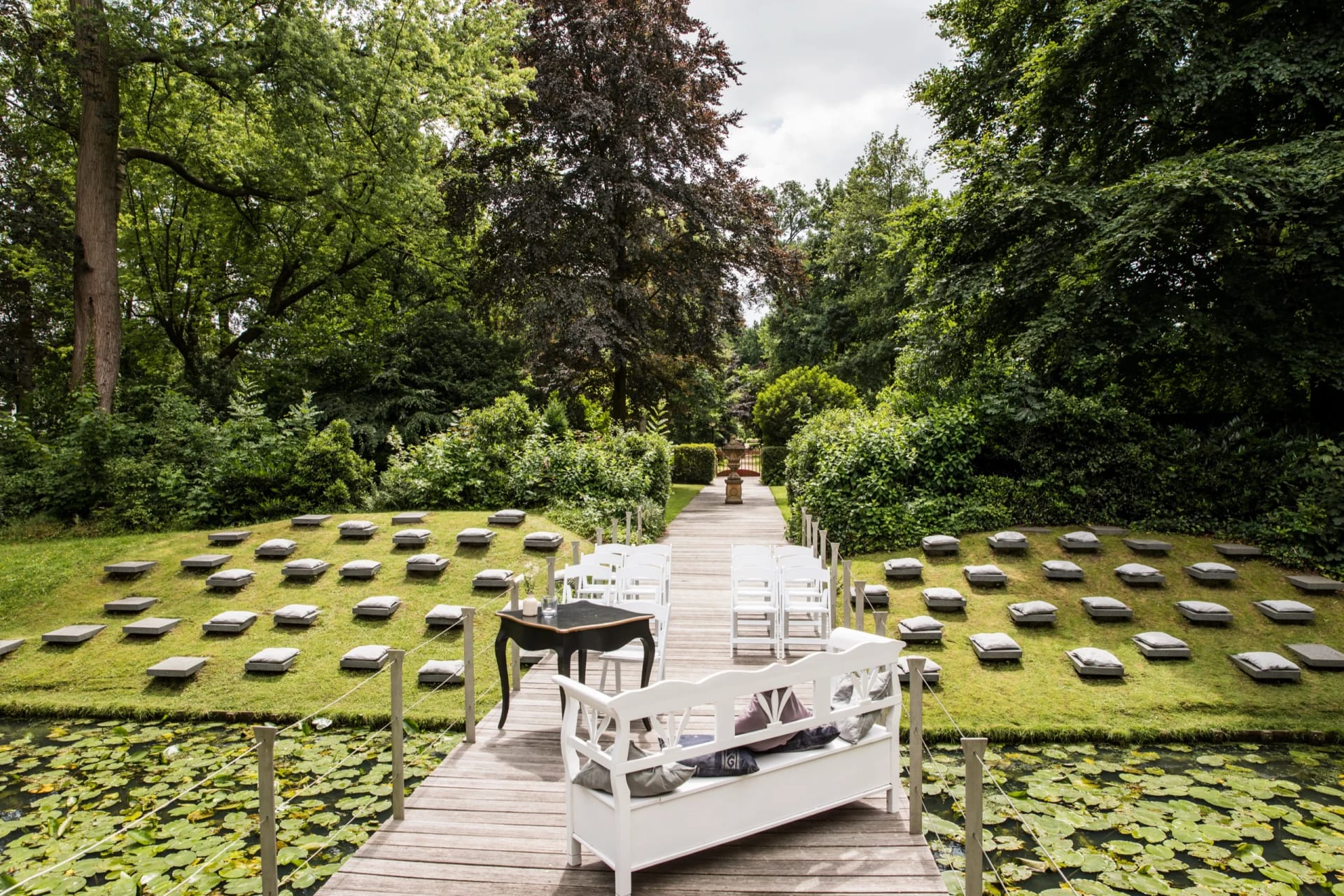
That is why the market for party catering, hire companies, event agencies and venues can feel so fragmented. Each supplier provides one piece of the puzzle, while the client is left coordinating the rest. For a party of 60 guests, that can easily mean dealing with four to six suppliers, each with their own delivery slots, terms and invoices.
If you are planning a party in the Sint-Oedenrode area or elsewhere in the Meierij region, our complete guide to planning a stylish celebration explains the wider decision-making process. This article goes a step further, focusing on budgets and practical requirements.
The market is also picking up. CBS reported that turnover for canteens and catering rose by 2.6 percent in the first quarter of 2026. Demand for on-site catering remains strong, so popular spring and summer weekend dates tend to book up early.
What does on-site party catering actually include?
On-site party catering means your caterer brings the kitchen, service team and event styling to your home, garden or chosen space, rather than inviting guests to a restaurant. Exactly what is included varies widely between suppliers, and that is often the difference between a seamless party and a stressful evening spent sorting out problems.
The food and drink
This could mean a buffet, a walking dinner with canapés served around the room, a barbecue with chefs grilling on site, a food truck or a plated dinner. Your choice affects the space you need. A walking dinner needs room for guests to move around, while a plated dinner needs space for tables. If you are deciding between the two, our practical guide to choosing between a walking dinner and a buffet covers the key considerations.
The logistics
This is where a full-service party catering partner stands apart. La Casserole combines catering with styling, production, furniture hire, marquees and project management, all through one point of contact. We also work with trusted partners for lighting, sound, entertainment and food trucks. In practical terms, that can include poseur tables, tableware, refrigeration, a bar, staff, setup and clearing everything away afterwards.
There is no fixed price. Your quote will depend on guest numbers, the menu format, service duration and, above all, how much infrastructure your location lacks. Two parties with the same number of guests can have very different budgets simply because one has power and a level hard surface, while the other does not.
What does a garden party for 60 guests really cost compared with a venue?
Consider two anonymised budgets for the same event: 60 guests, a Saturday evening in June, welcome drinks and canapés, a buffet and a bar until midnight. One is held in a private garden, the other at a hired venue.
| Cost item | Garden party (60 guests) | Party venue (60 guests) |
|---|---|---|
| Space / venue hire | €0 | included in the venue hire period |
| 8×12 m marquee with flooring | hired separately | not needed |
| Portable toilets (2 units) | hired separately | included |
| Generator and power distribution | often needed when demand exceeds about 3 circuits | included |
| Refrigeration / refrigerated trailer | often needed | commercial kitchen refrigeration available |
| Party catering and service staff | priced per guest | priced per guest |
| Setup and breakdown | usually 1 day before and 1 day after | completed on the same day |
| Number of suppliers when booked separately | typically 4 to 6 | typically 1 to 2 |

The garden option comes out ahead when the first four items are already covered: a covered terrace, paved area, access to an indoor toilet and enough circuits in the consumer unit. If they are not, the balance shifts towards a venue, and not just financially. You are also buying a wet-weather backup and a kitchen that does not depend on the forecast.
What people consistently underestimate
The hidden cost is time, not money. Setting up a marquee with flooring usually takes a full day beforehand and half to a full day afterwards. In other words, your garden is out of action for three days, not just one evening. That is not an issue at a hired venue.
When a generator becomes essential
A useful rule of thumb is that heated food equipment, refrigeration and a sound system running at the same time can demand more power than a typical domestic supply can comfortably handle. Ask your caterer for a power schedule for every piece of equipment, then compare it with your consumer unit. If in doubt, a generator costs less than dealing with tripped breakers halfway through the party.
Checklist:
- Count the facilities you are missing: marquee, flooring, toilets, power and refrigeration. If three or more are missing, a hired venue is often the better value.
- Measure your hard-surfaced area. For 60 guests with a buffet, you will generally need 80 to 120 m² of usable space.
- Ask every supplier for delivery, setup and breakdown timings, then put them all into one schedule.
- Factor in three days of garden disruption, not just the party itself.
What rules apply to a party in your own garden?
This is where plans most often go wrong, and rarely in the way people expect. Three sets of rules can overlap.
First, there are building regulations. Since 1 January 2024, temporary structures such as party marquees fall under the Besluit bouwwerken leefomgeving, together with fire safety rules for the use of other locations. Whether you need to submit a notification or apply for permission depends on the marquee classification and local requirements.
Second, there are local event rules. According to Ondernemersplein, some events require an event permit, while others only need a notification. A notification is filed, while a permit is assessed. Allow several weeks to months for a permit process, whereas a notification is typically dealt with in days. Check the latest thresholds on your council’s website and on Lokaleregelgeving.nl.
Third, there is noise. Published local regulations show a commonly used standard: without an exemption, up to 50 dB(A) between 07:00 and 19:00, 45 dB(A) between 19:00 and 23:00, and 40 dB(A) between 23:00 and 07:00, measured at the façade of the nearest home. Many councils also have a rule under which one garden party per address each year does not count as noise nuisance under the APV. That is local policy, not a nationwide entitlement.
Food safety also matters. The NVWA requires anyone preparing or selling food to work with a food safety plan or hygiene code based on HACCP. According to Ondernemersplein, marquees and food trucks must also meet additional requirements for mobile workspaces, including suitable hygiene facilities and sufficient cold and hot drinking water. A caterer who cannot give a clear answer on this is a red flag.
Who is a garden party right for, and who should choose a venue instead?
A fully catered garden party is a great fit for:

- A couple with a generous back garden who want to start and end their wedding day at home, with 50 to 70 guests and a terrace that can double as a dance floor.
- A family celebrating an anniversary or birthday where guests live nearby and the personal value of hosting at home matters more than maximum convenience.
- A director or business owner planning an informal staff party on their own premises, with existing hardstanding and power already in place.
It is less suitable for two types of event. If your garden is mostly lawn and gravel, the savings can quickly disappear into flooring hire and the risk of rain. And if you are celebrating in autumn or winter, a marquee also means heating, lighting and weather risk, none of which applies to an indoor venue. If you are undecided, our comparison of getting married at home versus choosing an event venue provides a clearer guide to the tipping point.
How does the planning process work, from first enquiry to clearing up?
La Casserole follows five steps for on-site party catering. They are broad enough to use when comparing any supplier.
- Initial consultation and guest numbers. You share the date, guest count, preferred atmosphere and approximate budget. The caterer turns this into a party catering format that works for your available space.
- Site visit. The caterer checks the ground, vehicle access, power points and water supply. During site visits, La Casserole uses 25 metres as a practical guide for the distance between the unloading area and kitchen setup. If the route is longer or difficult to access, extra staff or trackway may be needed, and setup time increases.
- Proposal and budget. You receive one quote covering party catering, staff, furniture, marquee and production, so you do not have to compare separate line items yourself.
- Event schedule. Delivery times, setup order, serving times and breakdown are set out in one timeline, with clear contacts for the day itself.
- Delivery and handover. Chefs work on site, the service team follows the event schedule, and everything is cleared away and removed afterwards.
Step 2 is the most frequently underestimated. It is where you find out whether the event will run smoothly or turn into a logistical headache.
What should you ask a caterer before signing?
Six questions separate a serious event partner from a supplier who simply provides food.
- Do you work with a HACCP plan or approved hygiene code, and does this also apply to mobile setups? The answer should be yes, with clear evidence.
- Who is my point of contact on the day? You want one name and one phone number. With separate suppliers, you may have four.
- How much power does your equipment require, and will I need a generator? Ask for a breakdown by item.
- What happens if the weather is poor? Ask for a clear contingency plan, including the deadline for adding a marquee.
- Are setup, breakdown and removal included in the price? This is one of the most common unexpected costs.
- How do you handle noise limits and the finishing time? An experienced supplier will know the usual evening and night-time limits and ask whether a local exemption applies.
One further point on noise limits: some measurement rules apply a 10 dB correction when music has a clearly recognisable character. Whether this applies to your event depends on your council’s rules. Do not assume it does. Check first.
Checklist:
- Ask for an itemised quote covering food, staff, equipment and logistics.
- Set the finish time in the event schedule, including when the music needs to be turned down.
- Confirm in writing who will clear up and when hired equipment will be collected.
- Check with your council, well ahead of the date, whether a notification is enough or a permit is required.
Frequently asked questions
Do I need a permit for a garden party with 60 guests?
It depends on your local council. According to Ondernemersplein, some events require a permit while others only need to be reported. A private party in your own garden will usually be treated differently from a public event. Check your council’s website or Lokaleregelgeving.nl, and allow several weeks to months if a permit is required.
How late can music play at a garden party?
Published local regulations commonly set a limit of 40 dB(A) after 23:00 at the façade of the nearest home. This is usually 50 dB(A) during the day and 45 dB(A) in the evening. Many councils allow one garden party per address each year without treating it as noise nuisance under the APV. If you want to continue later, applying for an exemption is sensible.
How much does party catering cost per person?
There is no fixed rate because the price depends on the menu format, number of guests, service duration and the infrastructure missing from your venue. A staffed buffet generally costs more than drinks canapés, while a plated dinner requires more staff per guest. Always ask for an itemised quote so you can see food, staffing and equipment costs separately.
How much space do I need for 60 guests?
As a rule of thumb, 60 guests with a buffet need around 80 to 120 m² of usable space, depending on the catering style. A walking dinner needs circulation space, a plated dinner needs room for tables, and a barbecue needs extra space around the grill. Only count level, hard ground. Lawn only counts if you are hiring flooring.
What does a full-service caterer arrange that a standard caterer does not?
A full-service partner such as La Casserole provides catering alongside styling, production, furniture, marquees and project management through one point of contact. The real difference is the event schedule: delivery times, setup order and serving times are all coordinated in one timeline instead of being split between four suppliers. For a garden party requiring hired infrastructure, that usually saves the most hassle.
Conclusion
The choice between party catering in your own garden and a hired venue is not really about guest numbers. It comes down to what your property already has. Check five essentials: hard ground, power, toilets, vehicle access and a wet-weather plan. If three or more are missing, a venue is usually both more cost-effective and less stressful.
Take three practical next steps. First, measure your usable space and count the circuits in your consumer unit. Next, check with your council whether you need to submit a notification or apply for a permit. Only then should you request an itemised party catering quote, so you can assess food, staff and logistics separately. If you would like to understand the practical side of garden party catering first, you will find the principles La Casserole uses when planning each event.
About La Casserole
La Casserole is a full-service event partner based in Best, combining party catering, styling, production, hire and project management into one complete solution for corporate and private events. With more than 40 years of experience, its own event venues in Brabant and a trusted partner network, the company delivers events from concept through to execution. Its clients include marketing, HR and office managers, directors, couples and private hosts.
Looking to host a stylish event in Brabant? Let us handle it!
Sources
- Ondernemersplein (Rijksoverheid) — Ondernemersplein
- lokale regelgeving op Overheid.nl — Lokaleregelgeving
- NVWA — Nvwa
- CBS — Cbs
- per adres jaarlijks één tuinfeest — Repository
- Evenementen organiseren — Ondernemersplein, Rijksoverheid
- Beleid geluid in de openbare ruimte — Overheid.nl, Lokale wet- en regelgeving (CVDR)
- HACCP — Nederlandse Voedsel- en Warenautoriteit (NVWA)