

Quick summary
La Casserole advises companies planning an informal celebration at their own premises: a food truck works best for around 30 to 120 guests, provided there is an outdoor area with a solid surface and a relaxed format. Above that number, serving queues tend to grow and a fixed kitchen or event venue is usually the more practical logistical choice. The practical requirements should always be checked first.
- Power supply is the first potential problem: a food truck will usually need its own electrical circuit, not an extension lead from the office kitchen.
- Permit requirements vary by municipality, even within Brabant, so checking with the local council is essential.
- Music played from the truck may require a music licence, which is not automatically arranged by the organiser.
- HACCP is a legal requirement for any business preparing food, so ask to see the food safety plan.
- Tax: for a staff party with a meal, the Dutch Tax Administration uses a taxable value of €4,05 per meal in 2026.
Food truck at your office or an event venue? Where corporate parties go wrong
Based on La Casserole’s experience with corporate event enquiries, clients often have the concept in mind already: a food truck at the office or on company grounds, drinks on the side and music through a speaker. But nobody has checked the essentials. Power, surface conditions, permits, grease disposal and a rain plan. Those details determine whether the event feels effortless or whether someone from the organising team spends the whole evening holding an extension lead. (Services)
That is hardly surprising. In the event catering market, caterers, rental companies, food truck agencies and event planners often work alongside one another, with each supplier handling only part of the event. One company provides the truck, another the marquee, a third the furniture, while the client is left to deal with permits.
This guide focuses on the decision itself: when a food truck at your home or business premises is genuinely a better option than a party at an event venue in Brabant, and where the tipping point lies. Not based on instinct, but on guest numbers, serving speed, available space and regulations. For the tax implications of staff catering, see this guide to costs and tax rules for a company lunch on site, which covers calculations that also apply to corporate parties.
What can go wrong with a food truck on your own premises?
Picture this: an office manager at a technical services company with 90 employees books two food trucks for a summer party in the company car park. The budget works and the menu is set. At 17.30, they discover that both trucks are connected to the same electrical circuit. The dishwasher in the staff kitchen cuts out, the second truck loses power, and the first truck is suddenly cooking for all 90 people.
Common issues with food trucks at private or business premises include:
- Underestimating electricity use. Griddles, fryers and refrigeration use more power together than a standard household circuit can handle. In most cases, allow for a dedicated connection or generator for each truck.
- Serving speed becomes a bottleneck. One truck with one service hatch can generally produce only a few dozen portions every fifteen minutes. With 100 guests, that means a queue unless you have multiple serving points.
- Nobody has checked the permits. According to the Dutch government’s Ondernemersplein guidance, every municipality can set its own rules for mobile catering pitches. What is allowed without paperwork in one Brabant municipality may require notification or an exemption in the next.
- City centre access restrictions. The Dutch Chamber of Commerce notes that, since 1 January 2025, food trucks may only enter zero-emission zones in some municipalities if they produce no harmful emissions. For an event in a city centre, this can be a firm restriction.
- Weather. Without cover, a rainy outdoor event has to move inside, where there is rarely enough capacity for the full group.
The key point is this: a food truck is not simply an attractive backdrop. It is a mobile kitchen with technical requirements. If you only identify those requirements a week before the event, you are already too late.
Why booking separate suppliers rarely makes an outdoor party easier
The traditional approach is to split everything up: the truck from agency A, the marquee from rental company B, the bar from C and furniture from D. On paper, it may look like the lowest-cost route. In practice, it creates three problems that even a detailed plan cannot fully solve.
Nobody owns the gaps between suppliers
The marquee is in place and the truck has arrived, but there is no cable cover and no grease management solution. Each supplier has delivered exactly what was ordered. The gap between those orders is where the event starts to unravel. When you buy every element separately, the client effectively becomes the project manager, whether that role has been agreed or not.
Arrival times clash
A marquee needs hours to set up, while a food truck may want to be in position thirty minutes before the first guests arrive. Both need the same driveway. Without one coordinated delivery schedule, the truck will be waiting for the marquee crew to finish.
Legal responsibilities are left unclear
Two examples illustrate the issue. When music is played at an event, it is often unclear in advance who arranges any required music licence: the venue, the organiser or the supplier. With separate bookings, everyone assumes somebody else has taken care of it. The same applies to food safety. The NVWA requires every business that prepares or sells food to work with a food safety plan or hygiene code based on HACCP. The legal basis is set out in Regulation (EC) No 852/2004. A truck without a documented plan is not a bargain, it is a risk.
Another point that is often missed is tax treatment. A staff party held on company premises benefits from a more favourable arrangement, where snacks, drinks and entertainment fall outside the discretionary allowance under the Dutch work-related costs scheme. If a meal is served, the Dutch Tax Administration applies a fixed taxable value of €4,05 per meal in 2026. This changes the calculation between serving drinks and nibbles or providing a full meal, and therefore between a food truck and a seated dinner.
Put this into practice:
- Ask every food truck for its HACCP plan or hygiene code, and save it with the booking confirmation.
- Check with the municipality where the event is being held whether a pitch permit or exemption is required, even on private land. Rules vary by municipality.
- Confirm in writing who is responsible for the music licence: the venue, organiser or truck operator.
- If the event is in a city centre, check the zero-emission zone before booking a diesel truck.
- Decide whether you are serving meals or snacks only, then include the €4,05 per meal in your budget.
When does an event venue in Brabant become the better choice?
The tipping point is not the budget. It is the combination of guest numbers, serving capacity and available square metres. As a rule of thumb, a food truck on your own premises is usually the simplest option for up to around 60 guests. Between 60 and 120 guests, you will need a second serving point and covered space. Above that, a dedicated event venue with a professional kitchen almost always offers smoother service.
| Situation | Food truck at home or on your own premises | Party at an event venue |
|---|---|---|
| 30 to 60 guests | Often the simplest option, one truck is usually enough | Venue hire can take up a large share of the budget |
| 60 to 120 guests | Works with 2 serving points plus cover | Also a strong option, depending on the atmosphere you want |
| More than 120 guests | Queues will usually exceed 15 minutes | Generally easier to manage logistically |
| Power supply | A dedicated circuit or generator is needed for each truck | Available at the venue |
| Weather risk | A backup plan is essential, with a marquee or indoor space | Barely relevant |
| Permit | Varies by municipality and must be checked by the organiser | Usually handled by the venue |
| Setup time | Truck around 1 hour, marquee several hours | Venue is ready to use |
La Casserole does not begin with the menu. The process starts with a technical site visit: power points and available circuits, ground conditions and manoeuvring space for the truck, walking routes from service area to seating, and whether the group can fit indoors if it rains. That assessment then shapes the food concept, not the other way around. Choosing the menu first and trying to make the technical setup fit later often leads to additional costs.
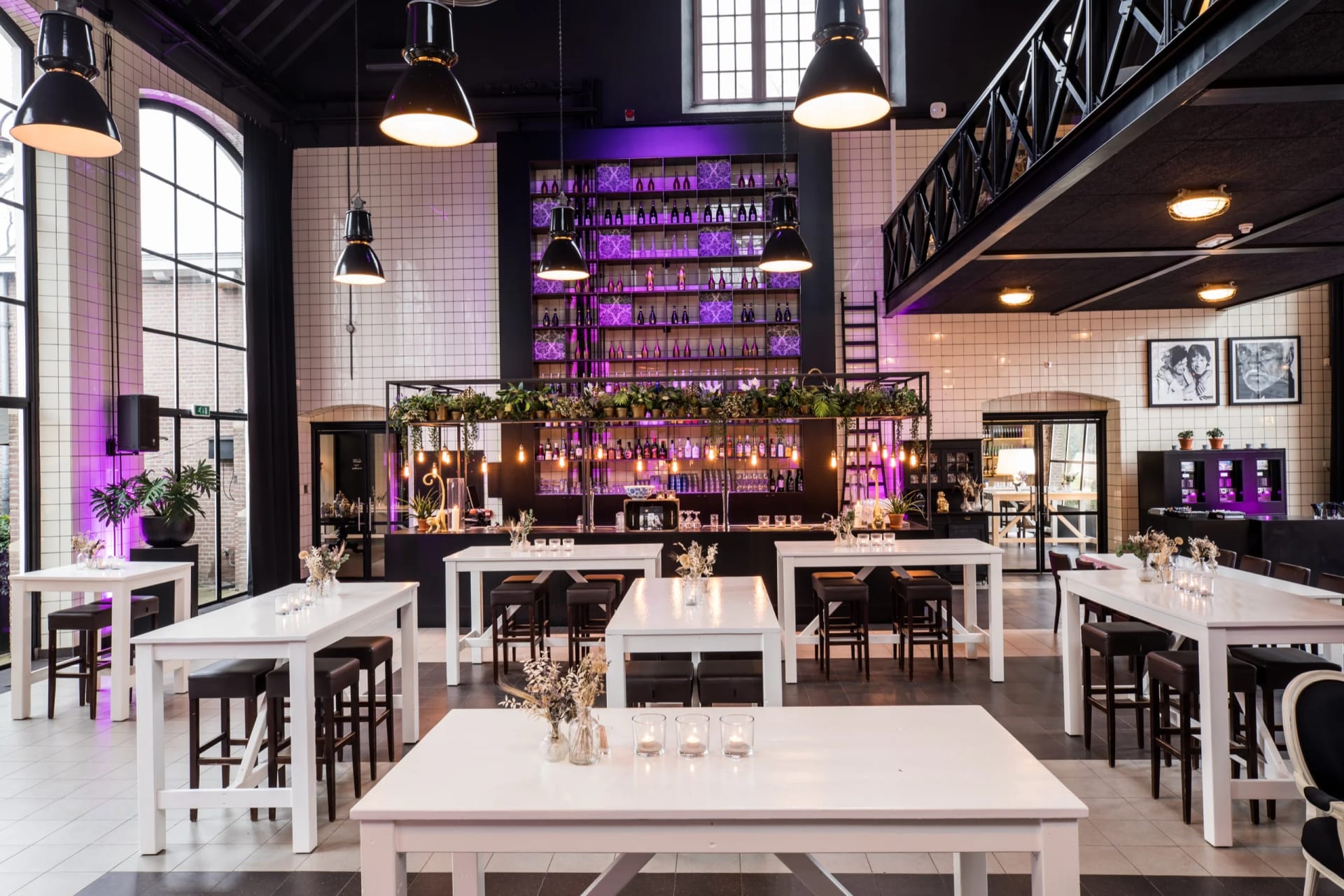
The benefit of working with one partner for catering, styling, technical equipment, furniture and marquees is that the gaps described above disappear. The delivery schedule is managed internally. For companies whose premises are not technically suitable, a dedicated event venue remains a practical alternative. Het Ketelhuis in Eindhoven, for example, can host up to around 400 guests in an industrial setting for launches, drinks receptions and team days, with power, acoustics and permits already built into the venue.
How do you organise a food truck event without the stress?
Follow these six steps in this order. The order matters. If you do step 4 before step 2, you will soon be back at step 1.
- Measure your space and assess your power supply. Record the number of spare circuits in the electrical panel, the distance from the panel to the truck location and the room available for manoeuvring. If in doubt, plan for a generator.
- Check local council requirements. Ondernemersplein makes clear that every municipality has its own rules for catering pitches, so check the specific municipality rather than Brabant as a whole.
- Set the serving time and serving capacity. Allow a few dozen portions per fifteen minutes for each serving point, then work backwards from the time you want food service to finish.
- Choose the format after that. Street food from the truck, a barbecue, a mobile coffee bar for a team day or a combination. Only at this stage does the menu become a free choice.
- Arrange a backup plan for weather and power. Think cover, heating and a second generator. A garden party catering plan that deals with power and weather in advance prevents most last-minute panic.
- Assign one point of contact. This person should make decisions on timing, positioning and any changes on the day, and should not also be responsible for hosting guests.
Step 3 is the one most often skipped. Serving capacity is not a minor detail. It shapes the entire guest experience. For example, an HR manager at a manufacturing company with 110 employees schedules food for 18.00 and a speech for 19.00. With one serving hatch, the last guest may not receive their plate until around 19.15, while the leadership team is already waiting to begin. With two serving points and staggered start times by department, the same group can usually be served within 35 to 45 minutes.
Put this into practice:
- Count your guests, divide the total by the number of serving points, and make sure the result stays below 50 guests per point.
- Above 60 guests per point? Add another serving point or stagger the start time by group.
- Allow at least 45 minutes between the final plate being served and the first speech.
- Name one decision-maker on the booking confirmation for the day itself.
- Schedule the technical site visit no later than four weeks before the event, not during the final week.
Frequently asked questions
How much does a food truck cost per person?
Food truck pricing generally has three parts: a travel fee, a per-person food charge, and potentially staff or technical equipment such as a generator. The per-person cost depends greatly on the number of courses and the length of service. Always ask whether power provision, service staff and waste removal are included, as these costs can vary widely between suppliers.
Do you need a permit for a food truck on private property?
It depends on the municipality. The Dutch government’s Ondernemersplein states that each municipality sets its own rules for catering pitches, so there is no single answer. It is often simpler on fully private land that is not open to the public, but noise, traffic or a large number of guests may still require notification or an exemption. Contact the municipality where the event will take place at least several weeks in advance.
How many guests can one food truck serve?
Use one serving point for every 50 guests as a rule of thumb for an informal event with one main course. One truck with one service hatch generally serves a few dozen portions every fifteen minutes, so waiting times become noticeable once there are more than 60 guests per point. For larger groups, two trucks or a combination of a truck and buffet works better than relying on one truck to cook for longer.
How does La Casserole help with a food truck at home or at a business premises?
With a technical site visit in advance and one point of contact during the event. La Casserole first confirms power capacity, ground conditions, walking routes and weather scenarios, then develops the food concept, including street food at home with service staff. Because catering, technical equipment, furniture and marquees are all scheduled together, the troublesome gaps between separate suppliers are removed.
Is a food truck suitable for a corporate event or only private parties?
It is suitable for both, but the tax treatment differs. For a staff party on company premises, snacks, drinks and entertainment fall outside the discretionary allowance under the Dutch work-related costs scheme. A served meal, however, has a fixed taxable value of €4,05 per meal in 2026. If you need to manage the available tax allowance, choose deliberately between a drinks-and-snacks format and a full meal.
Conclusion
A food truck at home or on company premises can work brilliantly, but only when technical requirements and regulations come before the menu. For up to around 60 guests, it is usually the easiest and most sociable option. Between 60 and 120 guests, you will need a second serving point, covered space and a dedicated power supply. Above that number, an event venue with a fixed kitchen will generally mean less stress and shorter queues.
The three checks that make the biggest difference are simple: measure the available power capacity, ask the local municipality about catering pitch rules and request the caterer’s HACCP plan. Tick off those three points and you can spend the evening with your guests, rather than managing logistics. That is what thorough preparation delivers, long before the day of the event.
Looking to host a stylish event in Brabant? Let us handle it!
Sources
- Ondernemersplein van de Rijksoverheid — Ondernemersplein
- KVK wijst erop — Kvk
- NVWA verplicht elk bedrijf dat voedsel bereidt of verkoopt — Nvwa
- telt de Belastingdienst in 2026 een vast bedrag van €4,05 per maaltijd bij het loon — Moore-drv
- Stappenplan foodtruck beginnen — Ondernemersplein (Rijksoverheid)
- Een foodtruck beginnen: houd hier rekening mee — KVK (Kamer van Koophandel)
- HACCP — NVWA (Nederlandse Voedsel- en Warenautoriteit)
- Voedselveiligheidsplan of hygiënecode voor horeca en ambachtelijke bedrijven — NVWA (Nederlandse Voedsel- en Warenautoriteit)